

NAK80 is a premium pre-hardened plastic mold steel developed for high-gloss appearance molds, precision texture patterns and short-cycle mold production. As a nickel-aluminum precipitation hardening steel, NAK80 is delivered with a stable factory hardness of approximately 38-42 HRC, allowing mold manufacturers to directly perform CNC machining, EDM processing, polishing and texture etching without additional heat treatment.
Unlike conventional pre-hardened steels such as 718H, NAK80 is specially optimized for mirror polishing and surface appearance. Compared with corrosion-resistant mold steels such as 2316 and S136, NAK80 focuses on superior polishing performance, dimensional stability and faster mold manufacturing rather than corrosion resistance.
The biggest advantage of NAK80 is its ability to achieve high-gloss mirror surfaces and fine texture effects while avoiding heat treatment deformation. It is widely used for 3C electronic products, cosmetic packaging, household appliances and other plastic parts where appearance quality is critical.
This article explains NAK80 mold steel properties, chemical composition, machining requirements, polishing methods, applications and comparison with 718H, 2316 and S136 to help mold makers choose the right steel for high-gloss plastic injection molds.
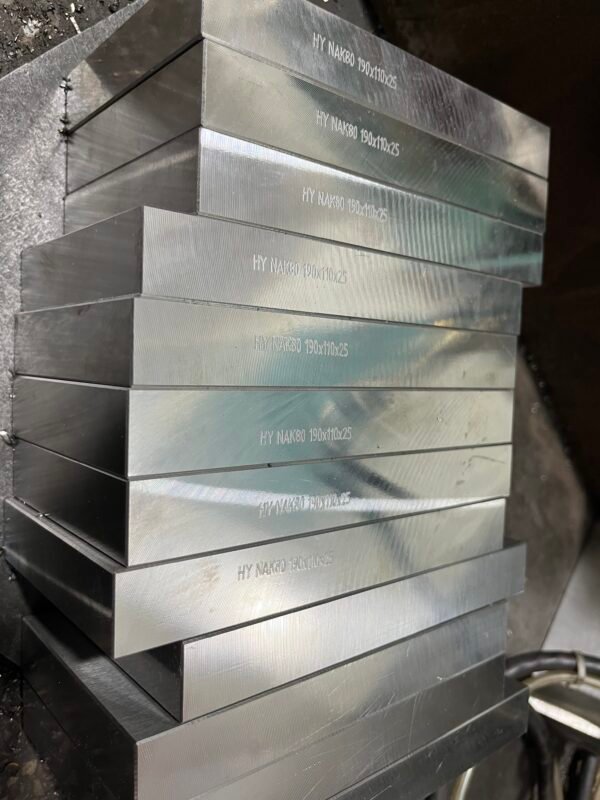
Key Performance Advantages of NAK80 Mold Steel
NAK80 is designed for appearance-focused plastic molds where surface quality, dimensional stability and manufacturing efficiency are the main priorities.
1. Pre-Hardened Steel Without Additional Heat Treatment
NAK80 is supplied in a pre-hardened condition with a typical hardness range of 38-42 HRC.
Because the steel has already completed the aging hardening process before delivery, mold manufacturers can directly proceed with machining and polishing without:
- Vacuum quenching
- Tempering
- Additional aging treatment
- Heat treatment deformation correction
This significantly reduces production time and eliminates dimensional changes caused by post-machining heat treatment.
For precision plastic molds requiring short delivery cycles, NAK80 provides a practical alternative to fully hardened mold steels.
2. Excellent Mirror Polishing Performance
Mirror polishing is one of the most important advantages of NAK80.
Through refined steel manufacturing and low impurity control, NAK80 provides a clean internal structure with excellent polishing characteristics.
After proper polishing procedures, NAK80 can achieve:
- High-gloss mirror surfaces
- Low surface roughness
- Reduced polishing defects
- Improved appearance consistency
Compared with ordinary pre-hardened steels such as 718H, NAK80 delivers better surface brightness and fewer polishing problems such as uneven gloss and surface marks.
It is especially suitable for:
- Transparent plastic parts
- Glossy consumer electronics housings
- Cosmetic packaging components
3. Superior Texture Etching Performance
NAK80 has a uniform fine-grain structure, making it highly suitable for precision texture processing.
It performs well in applications requiring:
- Leather grain textures
- Matte surface patterns
- Fine decorative textures
- Brushed and micro-pattern designs
The uniform material structure helps maintain consistent etching depth throughout the mold cavity, reducing problems such as uneven patterns or unclear texture edges.
For high-end appearance molds, NAK80 provides better texture stability than many conventional pre-hardened steels.
4. Excellent Dimensional Stability
Unlike traditional hardened mold steels, NAK80 achieves hardness through precipitation hardening instead of quenching.
This results in:
- Lower internal stress
- Minimal deformation during machining
- Stable cavity dimensions
- Better precision retention during production
It is especially suitable for:
- Multi-cavity molds
- Precision inserts
- High-accuracy appearance components
5. Good Machinability Compared With Hardened Stainless Steel
NAK80 offers better machining performance than fully hardened stainless mold steels such as S136.
Advantages include:
- Lower cutting tool wear
- Easier CNC finishing
- Reduced processing time
- Lower manufacturing cost
This makes NAK80 an attractive choice when customers need premium appearance quality without the longer processing cycle of hardened stainless steels.
Limitations of NAK80 Mold Steel
Although NAK80 provides excellent surface performance, it is not suitable for every plastic molding application.
1. Limited Corrosion Resistance
NAK80 does not contain a high chromium stainless structure, meaning it does not provide strong rust resistance.
It is not recommended for molds using:
- PVC materials
- Corrosive additives
- Flame-retardant plastics
- Moisture-sensitive production environments
For corrosive plastic applications, stainless mold steels such as 2316 or S136 are usually more suitable.
2. Not Suitable for High-Temperature Applications
NAK80 is designed for standard plastic injection molding conditions.
For molds exposed to continuous high temperatures or aggressive engineering plastics, higher-temperature-resistant materials should be considered.
Chemical Composition of NAK80 Mold Steel
NAK80 uses a nickel-aluminum precipitation hardening system. Its alloy design focuses on polishing quality, dimensional stability and uniform microstructure.
| Element | Content Range | Function |
|---|---|---|
| C (Carbon) | 0.08-0.16% | Low carbon content improves polishing performance and reduces surface defects |
| Ni (Nickel) | 3.00-4.00% | Provides precipitation hardening and improves toughness |
| Al (Aluminum) | 1.00-1.50% | Forms hardening compounds with nickel and stabilizes hardness |
| Mn (Manganese) | 1.40-1.80% | Improves machinability and processing stability |
| Si (Silicon) | 0.30-0.50% | Helps maintain structural stability and reduce stress |
| P | ≤0.010% | Controlled impurity to improve material quality |
| S | ≤0.005% | Reduces polishing defects and surface imperfections |
Main Applications of NAK80 Mold Steel
NAK80 is mainly selected for non-corrosive plastic molds requiring excellent appearance quality.
1. 3C Electronic Appearance Molds
Typical applications include:
- Smartphone housings
- Tablet covers
- Laptop shells
- Smart wearable products
- Electronic decorative components
These products require:
- High gloss surfaces
- Precise texture patterns
- Stable dimensions
2. Cosmetic and Packaging Molds
NAK80 is widely used for appearance-focused packaging molds, including:
- Cosmetic bottle caps
- Beauty product containers
- High-end plastic packaging
- Decorative plastic components
Its mirror polishing capability helps achieve premium surface appearance.
3. Household Appliance Plastic Molds
Applications include:
- TV front covers
- Air conditioner panels
- Small appliance housings
- Decorative plastic parts
NAK80 helps maintain consistent gloss and texture across large mold surfaces.
4. Precision Mold Inserts and Trial Molds
Because no additional heat treatment is required, NAK80 is suitable for:
- Prototype molds
- Fast delivery molds
- Precision replacement inserts
- Small and medium batch production molds
NAK80 Machining and Processing Guidelines
CNC Machining
Recommended practices:
- Use sharp carbide cutting tools
- Avoid excessive cutting heat
- Perform fine finishing before polishing
- Maintain stable cutting conditions
Typical machining parameters:
- Cutting speed: 80-120 m/min
- Feed rate: 0.15-0.25 mm/r
- Cutting depth: 1-2.5 mm
EDM Processing
During EDM machining:
- Use stable low-energy discharge parameters
- Remove the EDM affected layer before polishing
- Avoid excessive heat input
Residual EDM layers may reduce final polishing quality and affect texture appearance.
Mirror Polishing
Recommended polishing process:
320# → 800# → 1500# → 5000# sandpaper → Diamond paste polishing
Important points:
- Do not skip polishing steps
- Avoid excessive pressure
- Maintain uniform polishing direction
Correct polishing methods are essential for achieving the full mirror capability of NAK80.
Welding and Maintenance
NAK80 requires proper maintenance because it is not stainless steel.
Recommendations:
- Use suitable NAK80 welding materials
- Apply anti-rust oil regularly
- Protect mold surfaces during storage
Do not perform unnecessary heat treatment, as it may damage the original precipitation hardening structure.
NAK80 vs 718H vs 2316 vs S136 Comparison
| Performance | 718H | 2316 | NAK80 | S136 |
|---|---|---|---|---|
| Pre-hardened | Yes | Yes | Yes | No |
| Hardness | 30-35 HRC | 30-35 HRC | 38-42 HRC | 50+ HRC |
| Corrosion Resistance | Low | Excellent | Low | Excellent |
| Mirror Polishing | Medium | Good | Excellent | Excellent |
| Texture Etching | Medium | Good | Excellent | Excellent |
| Heat Treatment Required | No | No | No | Yes |
| Cost Level | Low | Medium | Medium-High | High |
How to Choose NAK80 Mold Steel
Choose NAK80 when:
- The mold requires mirror polishing
- Fine texture quality is important
- Fast mold delivery is needed
- Plastic material is non-corrosive
- Heat treatment deformation must be avoided
Choose another steel when:
- The plastic contains corrosive additives → choose 2316 or S136
- Optical-level mirror performance is required → consider S136
- Surface requirements are ordinary → 718H may be more economical
Common Mistakes When Using NAK80
1. Using NAK80 for Corrosive Plastics
Because NAK80 is not stainless steel, corrosive materials may cause cavity rust and surface damage.
2. Performing Secondary Heat Treatment
Additional quenching or high-temperature treatment can destroy the original precipitation hardening structure.
3. Excessive Polishing Pressure
Over-polishing may damage surface uniformity and affect texture quality.
4. Selecting NAK80 for Every Appearance Mold
NAK80 is excellent for high-gloss applications, but stainless steels remain better choices when corrosion resistance is required.
Conclusion: Is NAK80 the Right Mold Steel for Your Project?
NAK80 mold steel is one of the best choices for high-gloss plastic appearance molds that require mirror polishing, fine texture etching and short production cycles.
Its pre-hardened 38-42 HRC condition eliminates heat treatment processes, while its refined structure provides excellent polishing quality and dimensional stability.
For non-corrosive 3C, cosmetic and household appliance molds, NAK80 offers a balanced solution between 718H and high-cost stainless mold steels such as S136.
KUTU supplies genuine ESR refined NAK80 mold steel with hardness reports, material certificates and customized cutting services. Contact us for professional material selection and processing support for high-gloss plastic mold projects.
NAK80 (Pre-Hardened 40 HRC) Mirror Polishing Plastic Mold Steel Plate for Precision Molds – KUTU
S136 / S136H (Premium ESR Grade) Corrosion Resistant Stainless Plastic Mold Steel Plate – KUTU
718H (Premium P20+Ni Grade) High Polishing Plastic Mold Steel Plate Pre-Hardened – KUTU