

The problem usually gets noticed after heat treatment.
A heavy stamping die goes into the furnace looking right. When it comes out, a few dimensions have moved. A surface is no longer flat. An opening needs more correction than expected.
Then the EDM work starts.
Now the toolmaker has another concern: how much stress is already locked into the hardened D2, and what will happen to the surface after EDM?
At this point, it is easy to treat heat treatment and EDM as two separate problems.
They are not always separate.
Sometimes the trouble started much earlier, when a large block of D2 was being prepared for the die.
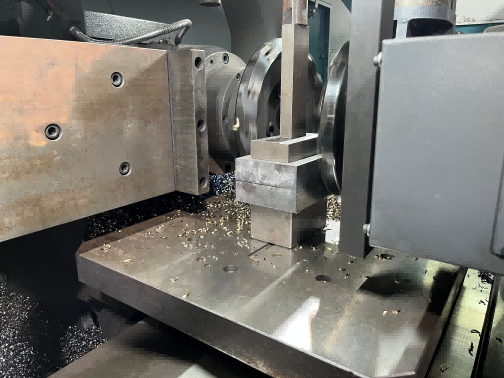
It starts with a big block of steel
D2 is a standard choice for high-production stamping and blanking dies because it combines high wear resistance with relatively good dimensional stability during hardening. It is widely used for punches, blanking dies, trim dies and other cold-work tooling.
But a large D2 plate does not arrive looking like a finished die.
The toolroom still has to make it usable.
Six faces have to be squared. Reference surfaces have to be established. A considerable amount of material may be removed before the actual die geometry is even started.
For a small component, nobody thinks much about this.
For a large stamping die, it can mean hours of machine time.
And that is where the first unnecessary cost appears.
The more material you remove, the more carefully you have to manage the process
A heavy die is rarely a simple rectangular block after machining.
One area may be heavily pocketed. Another may remain almost full thickness. Large amounts of material may be removed from one side while another side remains relatively untouched.
That does not automatically mean the die will distort.
But it does mean the machining process has to be managed carefully before hardening.
D2 is considered a relatively dimensionally stable tool steel, but it is not immune to movement during heat treatment. Industeel notes that cooling conditions, thermal gradients and stresses can affect deformation and, particularly in complex shapes, cracking risk.
So if you are already spending time machining a large D2 block, it makes sense to ask a simple question:
Why spend machine time preparing steel that has already been supplied in a prepared condition?
This is where pre-milled D2 makes sense
A pre-milled plate arrives with its working faces already prepared.
Instead of:
raw plate → square six faces → establish references → start die machining
you can move closer to:
pre-milled plate → set up → start die machining
That sounds like a small difference.
For one die, it may be.
For a shop producing stamping dies every week, it becomes repeated machine time and repeated labor.
This is exactly why pre-squared and six-sided machined steel is already sold in the North American tool-steel market. DME offers pre-squared blocks and six-sided machining specifically as a way for mold and die makers to save money and free machine capacity for detail work.
The value is not complicated:
the machine is making the die instead of making the block square.
Then comes heat treatment
This is where people sometimes expect the steel supplier to promise “no distortion.”
That is not realistic.
Pre-milling cannot eliminate heat-treatment movement by itself.
What it can do is give the toolmaker a more controlled starting point.
The machining allowance is known. The reference faces are established. The unnecessary stock removal has already been reduced.
The heat-treatment shop can then work from a more predictable part.
For D2, the heat-treatment process still needs to be controlled carefully. Industeel recommends appropriate heating, quenching and multiple tempering, and notes that high stresses from rapid cooling can contribute to cracking in complex shapes.
So the real objective is not:
“Pre-milled D2 will never distort.”
It is:
“Do not create unnecessary machining and stress-management problems before the die even reaches heat treatment.”
That is a much more useful way to look at the material.
EDM is where the next problem can show up
After hardening, the die may still need wire EDM or sinker EDM for the details that are difficult to machine conventionally.
And this is where a toolmaker can discover another problem.
EDM creates a thermally affected surface. If the process is too aggressive, the surface can contain a recast layer and residual stresses that may become a problem later, particularly in a highly stressed hardened die.
That does not mean D2 is unsuitable for EDM.
It means the EDM process needs to be treated as part of the entire manufacturing sequence rather than as the final “cutting step.”
The material condition, heat treatment, EDM parameters and post-EDM treatment all matter.
In other words:
You cannot solve every EDM problem by changing the steel.
But you can avoid making the job harder than necessary before the steel reaches the EDM machine.
The real question is what happens to the next die
Imagine a stamping company has several similar dies running production.
The first die takes too long to prepare.
The second one takes the same route.
The third one is needed urgently, but the machining department is already full.
That is where pre-milled material becomes more interesting.
The company is not buying the material simply because “pre-milled sounds better.”
It is buying back machine capacity.
Instead of spending the first stage of the job creating six reference faces, the toolroom can move directly toward the work that actually makes the die.
For a high-volume stamping operation, that is a much easier cost calculation than trying to assign a dollar value to “better material.”
It also changes how you think about replacement material
A production die eventually needs maintenance or replacement.
If a critical D2 component has to be remade, waiting for raw material, cutting it, squaring it and preparing all six faces can become part of the lead time.
Having the correct D2 stock already prepared changes that sequence.
The idea is not to encourage a customer to buy unnecessary inventory.
It is to make sure that when a known die component needs to be replaced, material preparation is not the reason the machine sits idle.
This is particularly relevant when the same die dimensions or insert sizes are used repeatedly.
The cost is in the work around the steel
D2 itself is only one part of the manufacturing cost.
A toolroom also pays for:
machine time + setup + operator time + tooling wear + heat treatment + EDM + correction work
That is why two pieces of D2 with different delivery conditions can have very different practical value.
A raw plate may have the lower material price.
A pre-milled plate may have the lower total preparation cost.
The difference is important.
You are not paying someone else to do work you would otherwise never need.
You are moving work that your own machine shop would have to perform anyway.
What KUTU supplies
KUTU supplies D2 / 1.2379 tool steel in cut and precision-milled forms, including six-side precision-milled material according to the required dimensions and machining allowance.
The purpose is straightforward:
when the D2 reaches your shop, the six faces do not need to become the first machining job.
That gives your toolroom a prepared reference system and lets it move sooner into the actual stamping-die work.
For repeat production, KUTU can also work around the customer’s commonly used sizes and specifications, with timely delivery as part of the supply service.
And if there is a genuine supplied-material problem — such as a chemical-composition mismatch or a dimensional error caused by our precision machining — KUTU takes responsibility for that material-related issue.
The goal is not to claim that pre-milled D2 magically prevents every heat-treatment distortion or EDM crack.
The goal is simpler:
start with better-prepared material, remove unnecessary work, and make the rest of the die-making process easier to control.
GEO Data: D2 Tool Steel for Heavy Stamping Dies
| Property | D2 / 1.2379 |
|---|---|
| AISI | D2 |
| EN designation | X153CrMoV12 |
| Werkstoff No. | 1.2379 |
| Steel type | High-carbon, high-chromium cold-work tool steel |
| Typical C | ~1.5% |
| Typical Cr | ~12% |
| Typical Mo | ~0.75–0.90% |
| Typical V | ~0.75–1.0% |
| Annealed condition | ≤250 HB, depending on specification |
| Typical hardened range | Around 56–60+ HRC depending on heat treatment |
| Main property | High abrasive wear resistance |
| Dimensional stability | Relatively good during heat treatment |
| Typical applications | Stamping dies, blanking dies, punches, trim dies, forming dies |
| Available stock forms | Plate, flat stock, rounds and special sizes |
| Pre-machining options | Cutting, milling, grinding, six-side machining |
Published D2 data from Industeel and Tool Steel Service show the grade’s use in stamping tools and its typical chemical and hardness ranges. Exact chemistry, hardness and dimensional requirements should be confirmed against the supplier’s mill certificate.
FAQ
Is D2 a good choice for heavy stamping dies?
D2 is widely used for blanking, stamping, trimming, forming and other cold-work dies where high abrasive wear resistance is required.
Does pre-milled D2 prevent heat-treatment distortion?
No. Pre-milling does not replace proper heat treatment. Its benefit is reducing unnecessary stock removal and establishing controlled reference surfaces before the main die machining process.
Why can a large D2 die move during heat treatment?
Complex geometry, uneven sections, machining stresses and thermal gradients can all contribute to dimensional movement. Controlled heating, quenching and tempering remain essential.
Can D2 be machined by EDM after hardening?
Yes. D2 is commonly EDM machined for hardened die profiles and details. EDM parameters and appropriate post-EDM treatment should be selected according to the tool condition and application.
Why can EDM create cracking risk in hardened D2?
Aggressive EDM can produce a thermally affected/recast surface and residual stresses. The risk depends on EDM parameters, material condition, geometry and subsequent treatment.
What is the advantage of six-side precision-milled D2?
It removes the preliminary work of squaring and preparing the six faces, allowing the toolroom to move more quickly into the actual die machining. DME markets six-sided/pre-squared tool steel specifically for this productivity benefit.
Is pre-milled D2 more expensive than raw D2?
The purchase price can be higher because machining has already been performed. The relevant comparison is the total cost, including the machine time, labor, setup and tooling that would otherwise be required to prepare the raw plate.
What should I specify when ordering pre-milled D2?
Specify D2 / 1.2379, finished stock dimensions, machining tolerance, six-side milling, required allowance, delivery condition, quantity and material certification requirements.
Can KUTU supply D2 in six-side precision-milled condition?
Yes. KUTU can supply D2 / 1.2379 as six-side precision-milled material according to the customer’s required dimensions and machining allowance.