

The mold is still producing parts, but the cavity surface is starting to show small pits.
With PVC or other chemically aggressive plastics, this is not unusual. The first reaction is often to repair the cavity: remove the damaged area, polish it again, put the mold back into production and continue.
But for a high-volume production mold, there is another question worth asking:
Is repairing the existing cavity actually the lowest-cost option?
The steel itself may not be the expensive part. The cost can come from taking the mold out of production, assigning machinists and polishers, reworking the cavity, assembling the mold again and running a trial before production can resume.
That changes the way corrosion-resistant mold steel should be considered.
DIN 1.2083 Stainless Plastic Mold Steel Plate & Bar | Precision Machined Anti-Corrosion Stock – KUTU
Choose the steel before corrosion becomes a production problem
1.2083 is a familiar choice for plastic molds working with corrosive molding compounds. It is an X40Cr14 stainless plastic mold steel, commonly associated with AISI 420, with approximately 12.5–14.5% chromium. European steel suppliers specifically list it for PVC and other chemically aggressive plastics.
Its value is not that a 1.2083 mold can never corrode.
No stainless mold steel should be treated that way.
The practical advantage is that you start with a material designed for this type of environment instead of accepting corrosion as a normal consequence of using a less suitable mold steel.
For a production tool that runs continuously, that decision is made before the first cavity is machined.
The bigger cost may appear when the mold needs attention
Imagine a PVC mold running several shifts a day.
After months of production, corrosion begins to affect one insert. The insert may still be repairable. But repair means more than the price of steel.
The tool may need to be removed from the machine. The damaged area needs machining or polishing. The insert has to be refitted. The mold may need another trial run.
If the mold is producing a high-volume part, every additional step has a cost.
This is why some manufacturers plan replacement components for critical tooling rather than waiting until a mold becomes a production emergency.
The idea is simple:
Do not wait for the mold to fail before thinking about the replacement.
The replacement does not necessarily have to mean a complete new mold. For many tools, a spare cavity insert, core or other critical component can be enough.
And when the component is needed, the material should not be the part that delays the job.
This is where ready-to-machine steel matters
Buying a raw block of 1.2083 is only the beginning.
Before the actual cavity or insert machining starts, a toolroom may need to square the block, establish the six reference surfaces and bring the material to the required dimensions.
Those operations consume machine time, operator time and capacity that could otherwise be used for the actual mold.
This is why pre-squared and six-side machined tool steel is already an established product form in the US and European markets. DME, for example, supplies pre-squared tool steel blocks and describes the benefit in terms of saving time, money, personnel and machine capacity. Diamond Metals reports that pre-squared blocks account for roughly 65% of its orders.
KUTU applies the same idea to mold steel supply.
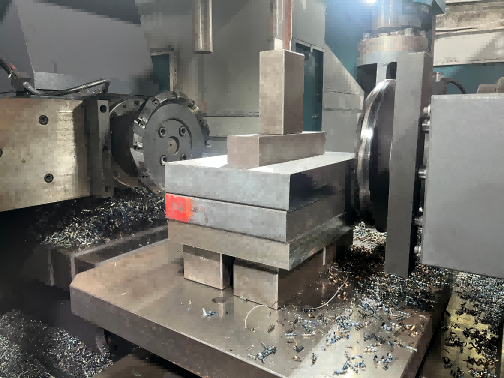
We provide 6-side precision-milled 1.2083, so the material arrives with all six sides precision milled instead of leaving the toolroom to prepare the raw block first.
The purpose is not to add another processing step to the purchase.
It is to remove one.
A spare material strategy can be simpler than emergency repair
For a frequently used mold, the question is not only:
“How long will this mold last?”
It can also be:
“How quickly can we put a replacement component into production if this one becomes a problem?”
That is a different way of looking at mold steel purchasing.
A manufacturer may already know which molds are critical, which inserts are exposed to corrosive plastics and which components would cause production problems if they suddenly needed repair.
For those components, keeping suitable steel or a ready-to-machine blank available can make more sense than starting the material purchase only after corrosion appears.
The objective is not to build unnecessary inventory.
It is to prevent a relatively inexpensive material purchase from becoming a production bottleneck.
Why 1.2083 is a practical choice for this strategy
1.2083 combines corrosion resistance with good machinability and polishability, which are important characteristics for plastic mold components. European suppliers list it for injection molding, blow molding and plastic extrusion, including applications involving corrosive plastics such as PVC.
For applications with particularly demanding polishability requirements, ESR versions of 1.2083 are also available.
The grade therefore makes sense when the production environment requires corrosion resistance but the manufacturer still wants a conventional mold steel that can be machined, polished and heat treated.
The exact grade should still be selected according to the resin, mold design, surface-finish requirement and production conditions.
The real saving is the time around the steel
A block of mold steel has a material value.
But a mold shop also has:
- machine hours,
- machinist hours,
- polishing time,
- setup time,
- production capacity,
- trial-run time,
- and the cost of taking a production mold out of service.
Six-side precision milling does not eliminate those costs.
It removes one part of them before the material reaches the mold shop.
And when the material is supplied quickly, the same principle applies to replacement work: the steel can be ready when the production schedule needs it, rather than becoming another item on the emergency procurement list.
For KUTU, this is the practical role of 1.2083.
Not simply selling a corrosion-resistant steel grade, but supplying 6-side precision-milled mold steel with a focus on timely delivery, so the customer can move from material receipt to actual mold machining with fewer preparation steps.
DIN 1.2083 for PVC/PVDC Mold Applications
| Property | DIN 1.2083 |
|---|---|
| Werkstoff No. | 1.2083 |
| EN designation | X40Cr14 |
| Common AISI equivalent | AISI 420 |
| Steel type | Corrosion-resistant plastic mold steel |
| Carbon | 0.36–0.42% |
| Chromium | 12.5–14.5% |
| Delivery condition | Up to approx. 241 HB, depending on supplier |
| Typical working hardness | Approx. 50–55 HRC, depending on heat treatment |
| Corrosion resistance | Good |
| Polishability | Very good |
| Machinability | Good in suitable delivery condition |
| Typical applications | Plastic molds, inserts, extrusion tooling |
| Corrosive plastics | PVC and other chemically aggressive molding compounds |
| Available processing | Sawing, milling, grinding and 6-side machining depending on supplier |
The chemical composition and typical hardness ranges above are published by European 1.2083 suppliers; actual delivery condition and heat-treatment specifications should be confirmed against the mill certificate and purchase specification.
1.2083 vs. 1.2316 for corrosive plastic molds
| Factor | 1.2083 | 1.2316 |
|---|---|---|
| Steel family | Stainless plastic mold steel | Stainless plastic mold steel |
| Main alloying feature | ~12.5–14.5% Cr | Higher Cr with Mo addition |
| PVC applications | Commonly used | Particularly suited to demanding corrosion environments |
| Polishability | Very good | Very good |
| Typical use | Cavities, inserts, plastic molds | Corrosive plastic molds, cavities and inserts |
| When to consider | Standard corrosion-resistant tooling | Higher corrosion demand or specific production conditions |
The choice between the two should be based on the actual molding environment rather than assuming that every PVC mold requires the higher-alloy option.
FAQ
Is 1.2083 suitable for PVC molds?
Yes. 1.2083 is widely specified as a corrosion-resistant plastic mold steel and is used for molds processing corrosive plastics such as PVC.
What is 1.2083 steel equivalent to?
1.2083 is designated X40Cr14 under EN/DIN systems and is commonly associated with AISI 420. Exact equivalence should be checked against the applicable standard and mill certificate.
What is the typical hardness of 1.2083?
One European supplier lists a typical working hardness of 50–55 HRC, while delivery condition can be around 241 HB maximum. Actual hardness depends on heat treatment and supply condition.
Why use 6-side precision-milled 1.2083?
Six-side precision milling removes much of the preliminary squaring and reference-surface preparation that a toolroom would otherwise perform before machining the mold component. US tool-steel suppliers specifically market pre-squared and six-side machined blocks as a way to save machine time, labor and production capacity.
Should a PVC mold have spare 1.2083 material?
For critical, high-volume tooling, keeping suitable replacement material or a replacement insert ready can reduce the risk of waiting for material procurement when a component requires replacement. Whether this is economical depends on the mold’s production volume, replacement lead time and downtime cost.
Does 1.2083 eliminate corrosion?
No. 1.2083 is corrosion-resistant, not corrosion-proof. Surface condition, heat treatment, molding material, moisture, cleaning and operating conditions all affect actual corrosion behavior.
What should I specify when ordering replacement 1.2083?
Provide the required steel grade, dimensions, delivery condition, tolerance, surface requirements, quantity and whether 6-side precision milling is required. For urgent replacement work, confirming the required finished stock size and delivery date at the quotation stage can avoid another machining or procurement delay.