

Large plastic injection molds require substantial amounts of steel. A mold base may contain thick support plates, cavity plates, core blocks, backing plates and other structural components.
For mold manufacturers, the material cost is only one part of the total manufacturing cost. Machining time, heat treatment, dimensional stability, material preparation and delivery schedules all affect the final mold cost.
This is why pre-hardened P20 mold steel is widely used for plastic mold bases and many general-purpose cavity components.
Supplied at approximately 28–32 HRC, P20 can usually be machined directly without a separate hardening and tempering cycle after machining. This simplifies production, reduces the risk of heat-treatment distortion and makes it a practical choice for large mold components that do not require the hardness of specialized tool steels.
However, choosing P20 for large tooling still requires attention to section size, hardness uniformity, surface requirements and the actual function of each component.
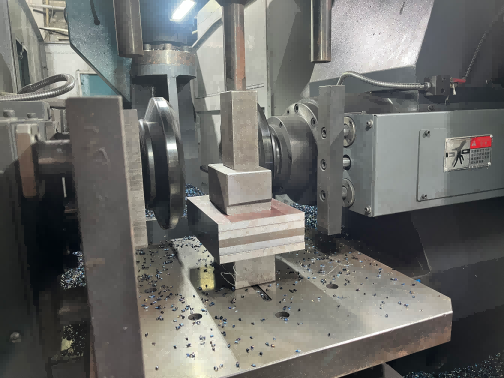
1. Why Pre-Hardened P20 Is Widely Used for Plastic Mold Bases
The main advantage of pre-hardened P20 is that the steel arrives in a usable hardness condition.
Conventional annealed steel generally needs to be machined, heat-treated and then finished to achieve its final working condition. For large mold plates, this can introduce additional manufacturing operations and dimensional-control challenges.
P20 changes that workflow.
It is supplied already hardened and tempered, typically at approximately 28–32 HRC. For many plastic mold applications, this hardness is sufficient for the component’s intended function.
The mold manufacturer can therefore proceed with machining without arranging another conventional hardening and tempering cycle.
The practical benefits include:
- No additional hardening cycle for many standard applications
- Lower risk of distortion associated with post-machining quenching
- Reduced heat-treatment scheduling and handling
- Good machinability in the supplied condition
- A useful balance of hardness, toughness and cost
- Suitable properties for many plastic mold bases, cores and cavity blocks
The benefit becomes more important as component size increases.
A small insert is relatively easy to rework if heat treatment causes dimensional changes. A large cavity plate or mold block is a different matter. Additional correction machining can consume considerable machine time and delay subsequent assembly.
Pre-hardened P20 helps avoid that extra process for applications where its supplied hardness is sufficient.
2. P20 Steel: Key Technical Data
P20 is a chromium-manganese-molybdenum plastic mold steel. It is commonly associated with DIN 1.2311 and the designation 40CrMnMo7.
The following figures are representative of commonly published P20 specifications. Exact chemical limits can differ between standards and manufacturers.
| Technical Parameter | P20 / 1.2311 |
|---|---|
| Steel type | Pre-hardened plastic mold steel |
| Carbon (C) | 0.28–0.40% |
| Silicon (Si) | 0.20–0.80% |
| Manganese (Mn) | 0.60–1.00% |
| Chromium (Cr) | 1.40–2.00% |
| Molybdenum (Mo) | 0.30–0.55% |
| Typical delivery hardness | 28–32 HRC |
| Approximate Brinell hardness | 280–320 HB |
| Main alloying elements | Cr, Mn, Mo |
| Main characteristics | Machinability, toughness and moderate wear resistance |
The chemical composition above represents a commonly published P20 specification, not a universal limit for every 1.2311 product. The agreed material standard governs the supplied steel.
The relatively moderate hardness of P20 is intentional.
It allows manufacturers to machine large components efficiently while retaining sufficient strength and toughness for many plastic mold applications.
P20 is not designed to replace high-hardness cold-work tool steels such as D2 or DC53. Its value lies in providing a practical balance for plastic mold construction.
3. Which Mold Components Are Suitable for P20?
Not every component in an injection mold needs the same material properties.
A mold contains structural components, cavity-forming components and localized areas exposed to higher wear. Selecting one expensive steel for every component can increase material costs without improving the overall mold performance.
P20 is commonly suitable for the following applications.
Mold Base Plates
Mold base plates provide structural support and maintain the alignment of the mold assembly.
These components generally do not require the high hardness of cold-work tool steel. Pre-hardened P20 offers sufficient hardness for many applications while remaining machinable.
Cavity Plates and Core Blocks
P20 can be used for cavity and core components in general-purpose plastic injection molds.
It offers good machinability and polishability for many standard surface-finish requirements.
However, when the mold requires a demanding mirror finish, processes highly abrasive glass-fiber-reinforced plastics, or operates under severe corrosion conditions, a different grade may be more appropriate.
Support and Backing Plates
These components are primarily structural.
P20 can be suitable when the design requires the strength and hardness of a pre-hardened alloy steel. For components with less demanding mechanical requirements, lower-cost structural steels may also be considered.
Large Mold Blocks
For large cavity blocks, the material selection should consider more than the nominal hardness.
The actual block thickness, cross-sectional hardness distribution, machining allowance and required surface quality all matter.
This is particularly important when selecting between standard P20 and nickel-modified P20+Ni.
4. Standard P20 vs. P20+Ni (1.2738): Which Is Better for Large Molds?
One common purchasing mistake is treating P20 and P20+Ni as interchangeable grades.
They belong to the same general plastic mold steel family, but their alloy designs and performance characteristics differ.
P20+Ni, commonly associated with DIN 1.2738 and the designation 40CrMnNiMo8-6-4, contains additional nickel.
This improves hardenability and helps achieve more uniform hardness through thicker sections.
For large cavity blocks, that can be an important advantage.
| Comparison | Standard P20 / 1.2311 | P20+Ni / 1.2738 |
|---|---|---|
| Nickel addition | No intentional nickel addition in the standard composition | Approximately 0.85–1.15% Ni in a common 1.2738 specification |
| Typical delivery hardness | Approximately 28–32 HRC | Depends on the supplier’s delivery condition; commonly supplied pre-hardened |
| Through-section hardness | Suitable for many standard section sizes | Improved hardenability and hardness uniformity in larger sections |
| Machinability | Good | Good |
| Typical applications | General plastic molds and mold base components | Large cavity blocks, cores and larger plastic mold components |
| Material cost | Generally lower | Generally higher |
For a standard mold base with moderate section thickness and ordinary service requirements, P20 is often the more economical choice.
For a large cavity block where consistent hardness through the section is important, P20+Ni deserves consideration.
The decision should be based on the actual block dimensions and required properties rather than simply choosing the more expensive grade.
5. Why Pre-Hardened Steel Can Reduce Total Mold Manufacturing Cost
Comparing mold steel only by price per kilogram can produce misleading purchasing decisions.
Consider a manufacturer preparing a large injection mold plate.
With annealed material, the production route may involve:
- Initial material preparation
- Rough machining
- Stress-relief treatment, where required
- Heat treatment
- Distortion inspection
- Correction machining
- Final machining and finishing
With pre-hardened P20, many applications can follow a simpler route:
- Material preparation
- Rough machining
- Stress relief, where required by the machining plan
- Final machining
- Inspection and mold assembly
The exact sequence depends on component geometry and machining strategy, but the key difference is that a separate hardening and tempering cycle is generally unnecessary.
This can reduce:
- External heat-treatment costs
- Heat-treatment transportation and handling
- Risk of dimensional distortion from additional hardening
- Correction machining
- Production scheduling complexity
For large mold components, these costs can be significant.
However, pre-hardened P20 does not eliminate every form of machining distortion. Residual stress, uneven stock removal, clamping forces and machining sequence can still affect dimensional accuracy.
A suitable roughing and finishing strategy remains important.
6. When P20 Is Not the Right Choice
P20 is a practical general-purpose plastic mold steel, but it is not suitable for every molding environment.
| Application Requirement | Material Consideration |
|---|---|
| General-purpose injection mold bases | P20 / 1.2311 |
| Large cavity blocks requiring better through-section hardness uniformity | P20+Ni / 1.2738 |
| High-volume molds processing abrasive glass-fiber-reinforced plastics | Consider higher-wear-resistance grades or localized hardened inserts |
| Highly polished optical or transparent plastic molds | Consider cleaner premium plastic mold steels |
| Corrosive plastics such as PVC and PVDC | Consider corrosion-resistant stainless mold steels such as 1.2083 or suitable higher-corrosion grades |
| Components requiring substantially higher hardness | Select a grade designed for the required hardness and service conditions |
The important point is to match the material to the function of each mold component.
A large mold does not automatically require premium steel throughout the entire assembly.
In many cases, using P20 for the structural and general cavity components while selecting higher-performance steel only for critical inserts is a more economical engineering solution.
7. Why Six-Side Precision-Milled P20 Plates Matter
Selecting the correct grade is only the first step.
The condition in which the steel arrives also affects the mold manufacturer’s production cost.
Many overseas mold shops purchase large blocks of steel and then carry out the initial preparation locally.
Before CNC machining can begin, the material may need to be:
- Squared and levelled
- Milled on multiple faces
- Prepared to establish machining references
- Measured and checked against the required dimensions
These operations consume machine capacity and operator time.
For a manufacturer handling several large mold projects, the accumulated preparation work can become a significant part of production overhead.
This is where six-side precision-milled material offers a practical advantage.
At KUTU MOLD STEEL, we supply mold steel blocks that are precision milled on all six sides before shipment.
The customer receives material with prepared reference surfaces and agreed dimensions, rather than simply receiving rough-cut stock.
This helps reduce the initial squaring and preparation work required after delivery.
The benefits include:
- Less local material-preparation work
- Reduced machine time spent on initial face milling
- Prepared reference surfaces for subsequent machining
- More predictable material preparation
- Better use of internal CNC capacity
The actual benefit depends on the drawing, dimensional allowance and the customer’s existing machining process.
Our objective is not to claim that every six-side milled block will reduce costs by a fixed percentage. It is to help mold manufacturers compare the complete purchasing and preparation cost rather than the steel price alone.
8. What Should Buyers Specify When Ordering P20 Plates?
A quotation request should contain enough information to identify the correct material and machining requirements.
For large mold blocks, buyers should provide:
| Required Information | Why It Matters |
|---|---|
| Steel grade | Distinguishes P20 / 1.2311 from P20+Ni / 1.2738 and other variants |
| Finished dimensions | Determines the required starting size and machining allowance |
| Quantity | Helps plan material preparation and delivery |
| Required delivery hardness | Confirms the appropriate pre-hardened condition |
| Six-side milling requirement | Defines the preparation scope |
| Dimensional tolerance | Establishes the required accuracy of the finished stock |
| Inspection requirements | Clarifies whether additional testing or documentation is required |
| Material certificate | Provides traceability of chemical composition and supplied material |
For large blocks, it is also worth discussing the section size and hardness distribution before ordering.
A grade that performs well in a small sample does not automatically provide the same hardness uniformity through a much thicker section.
9. Why Work with KUTU MOLD STEEL?
KUTU MOLD STEEL focuses on supplying mold steel in a precision-machined condition for overseas mold manufacturers and industrial customers.
Our service is built around more than supplying a material grade.
We coordinate the material specification, dimensions, six-side precision milling, documentation and delivery requirements according to the customer’s project.
Our goal is to help customers reduce unnecessary preparation work after the material arrives.
You do not need to replace your existing steel supplier to evaluate this approach.
A practical starting point is to send us one set of drawings or one upcoming P20 plate requirement. You can compare the supplied dimensions, machining condition, documentation and total preparation cost with your current purchasing method.
For customers working with tight production schedules, we also coordinate delivery arrangements according to the material and machining requirements.
When a genuine material-quality issue is caused by the supplied material, we take responsibility for handling the material problem rather than leaving the customer to manage it alone.
The right mold steel should not only meet the drawing specification. It should also arrive in a condition that helps your machining department work efficiently.
FAQ: Pre-Hardened P20 Mold Steel
What is the typical hardness of pre-hardened P20 steel?
Pre-hardened P20 is commonly supplied at approximately 28–32 HRC, equivalent to roughly 280–320 HB. The actual delivery hardness depends on the manufacturer’s specification and material condition.
Why is P20 used for large plastic mold bases?
P20 combines moderate hardness, good machinability and useful toughness. Because it is supplied pre-hardened, many components can be machined without a separate hardening and tempering cycle, reducing production complexity and the risk of heat-treatment distortion.
Is P20 the same as 1.2311?
P20 is commonly associated with DIN 1.2311 and 40CrMnMo7. However, exact chemical composition limits can differ between specifications. Buyers should identify the applicable standard rather than assuming every product carrying the P20 designation is chemically identical.
What is the difference between P20 and P20+Ni?
P20+Ni, commonly designated 1.2738, contains additional nickel. It offers improved hardenability and is often selected for larger mold blocks where through-section hardness uniformity is important. Standard P20 is generally the more economical choice for many ordinary plastic mold applications.
Does pre-hardened P20 need further heat treatment after machining?
For many standard plastic mold applications, no additional hardening and tempering cycle is required because P20 is already supplied in its working hardness condition. Stress relief may still be considered depending on the component size, machining allowance and manufacturing process.
Can P20 be used for mirror-polished plastic molds?
P20 can achieve good polishing results for many standard applications. However, demanding optical or mirror-finish applications may require cleaner premium mold steels with more consistent internal structure.
Is P20 suitable for glass-fiber-reinforced plastic molds?
It can be used in selected applications, but glass fibers increase abrasive wear. For high-volume production, engineers should evaluate the wear requirements and consider localized wear-resistant inserts or a higher-performance mold steel.
What is six-side precision-milled P20?
It is P20 steel that has been precision milled on all six faces before shipment. The customer receives prepared reference surfaces and agreed dimensions, reducing the initial material-preparation work required before CNC machining.
Final Recommendation
For many general-purpose plastic injection molds, pre-hardened P20 remains a cost-efficient choice for mold bases, cavity plates and other large tooling components.
Its main advantage is the combination of usable delivery hardness, machinability and reduced dependence on additional heat treatment.
For larger cross-sections requiring more consistent hardness, P20+Ni / 1.2738 may be a better choice. For severe wear, corrosion or demanding optical finishes, specialized mold steels should be evaluated instead.
Once the material grade has been selected, the supply condition deserves equal attention.
KUTU MOLD STEEL supplies P20 and other mold steel grades with six-side precision milling, helping mold manufacturers reduce local material-preparation work and move more efficiently into CNC machining.
Send us your required grade, block dimensions and machining requirements to discuss a suitable material and preparation solution.