

The press is running at full speed when the first bad parts appear.
The operator notices a small burr on the stamped edge.
Then another.
The next batch shows the same problem.
Production stops. The die is pulled from the press, and the punch edge is inspected under magnification. There it is — a series of tiny chips along the cutting edge.
The punch has not completely failed. That is almost what makes the problem more frustrating.
It was supposed to keep running.
Now someone has to remove the damaged insert, inspect it, decide whether it can be reground, and work out how quickly a replacement can be made.
On a high-speed stamping line, micro-chipping is rarely just a tooling problem. It can become a production problem very quickly.
And if the same D2 or SKD11 punch keeps coming back from the press with chipped edges, simply grinding it again may not solve the underlying issue.
A tiny chip can become a production problem very quickly
Micro-chipping often starts small.
You may not even notice it during the first few cycles. The punch still looks usable, and the press continues running.
But once the cutting edge loses its geometry, the stamped material no longer separates cleanly. Burrs increase. Part dimensions can start moving out of tolerance. Eventually, the tool has to come out of the press.
On a high-speed line, the number of cycles makes this more serious.
A punch may be striking the material thousands of times during a production run. A small weakness at the cutting edge is being loaded over and over again.
That weakness can come from several places:
- Heat treatment that leaves the steel too brittle.
- An edge that is too thin or poorly supported.
- Incorrect punch-to-die clearance.
- Misalignment during stamping.
- Carbide distribution or material-quality issues.
- Wire EDM damage or insufficient finishing.
- Excessive local stress around corners and transitions.
This is why changing the steel grade without checking the failure mechanism can be disappointing.
The question is not simply, “Which steel is harder?”
It is, “Why is this edge breaking under this particular production condition?”
Why SKD11 is still widely used for stamping dies
SKD11 remains a common choice for cold-work tooling because it provides a useful combination of high hardness and wear resistance.
Its high carbon and chromium content allows it to develop a hard, wear-resistant structure after appropriate heat treatment. Typical JIS SKD11 chemistry is approximately:
- Carbon: 1.40–1.60%
- Chromium: 11.00–13.00%
- Molybdenum: 0.80–1.20%
- Vanadium: 0.20–0.50%
That makes SKD11 suitable for punches, blanking dies, forming dies and other components exposed to repeated abrasive and mechanical loading.
But there is an important distinction between wear and chipping.
A worn punch gradually loses its cutting ability.
A chipped punch loses pieces of its cutting edge.
Those are different failure modes.
If your tool is wearing too quickly, increasing wear resistance may make sense.
If the edge is breaking before the expected sharpening interval, simply pushing hardness higher may not be the answer.
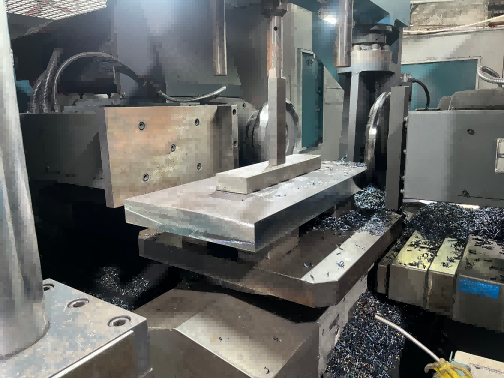
JIS SKD11 Standard High Wear Hardware Mold Steel Plate | 6-Face Precision Milled Stock – KUTU
Where micro-chipping really begins
Imagine a punch running at high speed.
The punch enters the sheet. The material begins to deform. The cutting edge experiences a combination of compression, shear and impact. The punch retracts and immediately prepares for the next cycle.
Then the process repeats.
Again.
And again.
The edge does not have time to “recover.” Every cycle adds another loading event.
If the punch geometry creates a stress concentration, or the heat treatment has left the edge too brittle, the damage can begin as a microscopic crack.
Once the crack reaches the edge, a small piece breaks away.
That is the chip the operator eventually sees.
This is why the failure investigation should normally start with the actual damaged insert.
Where did the first chip appear?
Was it at a corner?
Was it along a long unsupported edge?
Did it appear shortly after heat treatment?
Did it start after wire EDM?
Did the problem occur only when stamping a particular material?
These questions can tell you much more than the hardness number printed on the material certificate.
Precision-squared SKD11 does not make the edge unbreakable
This distinction matters.
Six-side precision milling does not prevent micro-chipping by itself.
What it does is remove unnecessary preparation work before the actual die machining begins.
A conventional SKD11 block may arrive with all six faces requiring squaring and milling. Before the machinist can properly establish the component geometry, reference faces have to be prepared.
For a busy toolroom, that means machine time, setup time and operator time.
With six-side precision-milled SKD11, the block arrives with prepared reference surfaces.
The workshop can move more quickly into the actual machining of the punch, insert or die component.
That is particularly useful when replacement parts are needed urgently.
The production line does not care how long it takes to prepare a raw steel block.
It only cares when the replacement punch will be ready.
The real value appears when a replacement is needed
Consider what happens after a punch chips during a production run.
The damaged insert is removed.
The toolroom checks whether the edge can be reground.
If the damage is too deep, a replacement has to be made.
Now the clock starts.
The steel has to be available. The block has to be prepared. The component has to be machined. Then it may require heat treatment, grinding, EDM and final inspection.
Every additional preparation step pushes the replacement further away.
This is where precision-milled SKD11 becomes more than a machining convenience.
For a workshop that regularly produces replacement punches and inserts, having six-side precision-milled stock ready for machining can remove one part of the preparation process before the emergency begins.
The material does not need to be squared from scratch.
The machinist can establish the component geometry from prepared faces and move directly into the required machining operations.
The difference may be only a few hours on one component.
But when a production line is waiting, those hours are not insignificant.
What if the SKD11 itself is the problem?
Sometimes it is.
If multiple inserts show similar failures despite consistent machining, heat treatment and die clearance, material quality deserves closer attention.
SKD11 is a high-alloy tool steel with a significant carbide population. The distribution and size of carbides can affect toughness and resistance to cracking.
This is one reason why two pieces carrying the same grade designation should not automatically be assumed to perform identically.
For demanding stamping applications, material quality, cleanliness, forging condition and heat-treatment control all matter.
If micro-chipping keeps appearing, review the complete material and processing chain rather than looking only at the nominal grade.
That may also be the point where a different cold-work steel, such as DC53, becomes worth evaluating if toughness is the limiting factor.
The correct material depends on the failure.
Don’t confuse hardness with tool life
It is tempting to think that a harder punch should automatically last longer.
Sometimes it does.
But hardness and toughness are not the same property.
A very hard edge can resist abrasive wear well while becoming less forgiving when subjected to impact or concentrated stress.
For a high-speed stamping die, the best working condition is usually a balance between wear resistance, toughness, geometry and processing quality.
The final hardness should therefore be selected according to the application rather than simply chasing the highest number possible.
If the punch is wearing away too quickly, investigate wear.
If it is breaking, investigate brittleness and stress.
If it is producing burrs, inspect the cutting geometry and clearance.
And if the same problem appears across multiple replacement inserts, investigate the material and heat-treatment process as well.
What does precision-milled stock mean for production?
For procurement teams, the question is often simpler than the metallurgical discussion.
How quickly can I get usable material into the machine shop?
A raw block has to be prepared.
A six-side precision-milled block is already prepared.
That difference becomes more valuable when:
- replacement inserts are needed urgently;
- the workshop is already running at high machine utilization;
- several punches need to be produced;
- the customer has a tight production schedule;
- or the toolroom wants to reduce non-value-added stock preparation.
The saving is not only the milling itself.
It is also the machine capacity and labor that no longer need to be allocated to preparing the six faces.
For large or urgent components, that can be more important than a small difference in the price per kilogram.
When the next punch starts to chip
If your high-speed stamping line keeps producing chipped SKD11 edges, do not wait until the next failure to start investigating.
Take the damaged insert and look at the failure pattern.
Check the punch geometry.
Check the die clearance.
Review the heat treatment.
Check the EDM surface.
Confirm the material quality.
Then decide whether the problem is primarily wear, toughness, processing or design.
If SKD11 remains the correct grade, using six-side precision-milled SKD11 stock can make the next insert faster to manufacture.
And if the failure points toward insufficient toughness, a different grade such as DC53 may deserve a controlled production trial.
At KUTU MOLD STEEL, we supply SKD11 and other cold-work tool steels with six-side precision milling available for suitable sizes and requirements. The objective is straightforward: provide the material in a condition that reduces unnecessary preparation work and help customers get the required steel when the production schedule cannot afford to wait.
Because on a high-speed stamping line, the expensive part is often not the small piece of steel that chipped.
It is everything that has to stop after it does.
Quick Answer
SKD11 is a high-carbon, high-chromium cold-work tool steel commonly used for stamping dies, punches and blanking tools. Micro-chipping can be caused by excessive brittleness, unsuitable heat treatment, thin or unsupported edges, incorrect die clearance, material quality or EDM-related surface damage. Six-side precision-milled SKD11 does not directly prevent chipping, but it reduces initial stock-preparation work and can shorten replacement machining time.
SKD11 Key Data
| Property | Typical SKD11 Data |
|---|---|
| Standard | JIS G 4404 |
| Steel type | High-carbon, high-chromium cold-work tool steel |
| Carbon | 1.40–1.60% |
| Chromium | 11.00–13.00% |
| Molybdenum | 0.80–1.20% |
| Vanadium | 0.20–0.50% |
| Typical applications | Punches, blanking dies, stamping dies, forming tools |
| Main characteristics | High hardness and wear resistance |
| Main failure concern | Chipping can occur when toughness, geometry, heat treatment or working conditions are unsuitable |
Actual composition and mechanical properties should be confirmed against the applicable material standard and mill certificate.
Micro-Chipping Troubleshooting
| Failure pattern | What to investigate |
|---|---|
| Small chips along the cutting edge | Hardness, toughness, edge geometry and material quality |
| Chipping concentrated at a corner | Stress concentration, clearance and alignment |
| Cracking after heat treatment | Heat-treatment parameters, hardness and residual stress |
| Chipping after wire EDM | EDM parameters and recast/damaged surface layer |
| Increasing burrs before visible chipping | Cutting edge wear, clearance and punch alignment |
| Repeated failure on replacement inserts | Material quality, heat treatment and component design |
Six-Side Precision-Milled SKD11 vs. Raw Stock
| Factor | Raw SKD11 Block | Six-Side Precision-Milled SKD11 |
|---|---|---|
| Six-face preparation | Required by customer | Completed before shipment |
| Initial machine setup | Additional preparation | Reduced |
| Reference surfaces | Must be established | Prepared |
| Workshop labor | Higher | Lower |
| Machine capacity | Used for stock preparation | Available for component machining |
| Emergency replacement | More preparation steps | Faster start to machining |
Frequently Asked Questions
Does six-side precision milling prevent SKD11 micro-chipping?
No. Precision milling reduces stock-preparation work. Micro-chipping is mainly influenced by material quality, heat treatment, geometry, die clearance, EDM and operating conditions.
Why does SKD11 micro-chip in high-speed stamping?
Possible causes include excessive brittleness, unsuitable heat treatment, thin or unsupported cutting edges, incorrect clearance, misalignment, material-quality issues and EDM-related surface damage.
Is harder SKD11 always better for stamping dies?
No. Higher hardness can improve wear resistance, but excessive hardness can reduce toughness. The correct hardness depends on the punch geometry, stamped material and loading conditions.
What is the benefit of six-side precision-milled SKD11?
The six faces are precision milled before shipment, giving the customer prepared reference surfaces and reducing the machining work required before manufacturing the actual punch or die component.
When should a stamping manufacturer consider DC53 instead of SKD11?
DC53 may be worth evaluating when repeated chipping or cracking indicates that toughness is limiting tool life, particularly after geometry, clearance and heat-treatment issues have been reviewed.
Can precision-milled SKD11 reduce emergency replacement time?
It can reduce the initial block-preparation stage. The actual replacement time still depends on machining, heat treatment, grinding, EDM, inspection and the availability of the material.