

The press stops in the middle of the production run.
The operator has started seeing burrs on the parts.
A few pieces are pulled from the line and checked.
The punching insert has chipped.
Not completely. Not dramatically.
Just enough to make the parts unacceptable.
Now the toolroom gets the call.
The die has to come out. Someone has to inspect the damaged D2 insert and decide whether it can be reground or repaired.
And this is where the real production problem begins.
The cost is no longer the small piece of steel that chipped.
It is the time required to get the die back into production.
If this has happened before, the team already knows what comes next: repair the insert, put it back into the die, run a trial, and hope the same edge does not fail again.
But there are better ways to handle a recurring D2 chipping problem.
You can keep D2 and prepare replacement inserts in advance.
Or, if repeated chipping shows that D2 is not giving the insert enough toughness, you can move to DC53.
What is usually less attractive is waiting until the production line stops and then trying to recover the damaged insert.
The problem is not always the D2. It is the recovery time.
D2 is widely used for punching inserts because of its high wear resistance.
If an insert gradually wears after a long production run, D2 may be doing exactly what you expected.
But chipping is different.
A small piece breaks away from the cutting edge. The edge geometry changes. Burrs appear. The insert is removed before its planned maintenance interval.
The production team now has an unplanned repair.
That repair can involve:
Remove the die → inspect the insert → grind or remake → heat treatment → EDM/finishing → reinstall → trial run → production restart.
The steel itself may be one of the smallest costs in that sequence.
The larger cost is the time between the moment the defect is discovered and the moment acceptable parts are coming off the press again.
That changes how a factory should think about a recurring D2 failure.
The question is not simply:
“How do we repair this insert?”
It is:
“How do we make sure the next insert is ready before this happens again?”
There are two practical ways to reduce the risk
If D2 is otherwise performing well and the main problem is unexpected insert failure, there is no reason to change the entire material strategy immediately.
One option is simple:
Keep using D2, but prepare spare inserts in advance.
The material is already familiar to the toolroom. The heat-treatment process is established. The machining program is already available.
Instead of waiting for the active insert to fail, the replacement is already sitting on the shelf.
When the production team needs it, the damaged insert can be removed and the prepared spare can go in.
This approach makes particular sense when the failure is occasional and the existing D2 insert provides acceptable wear life.
But there is another situation.
If the same D2 insert keeps chipping again and again, stocking more D2 inserts only makes the replacement process faster.
It does not address why the edge keeps breaking.
That is when the second option becomes interesting:
Move the critical insert to DC53.
DC53 High Toughness Cold Work Die Steel Plate | Precision Machined Upgraded D2 Stock – KUTU
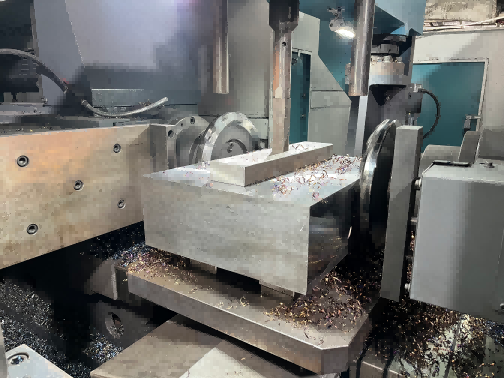
DC53 changes the material equation
DC53 is a high-hardness, high-toughness cold-work tool steel developed by Daido Steel.
Its main attraction is not simply higher hardness.
It is the balance between hardness, wear resistance and toughness.
That matters when the limiting failure is edge chipping rather than gradual wear.
A punching insert can experience repeated mechanical loading thousands of times during a production run. Thin sections, sharp transitions and concentrated loads can make the cutting edge particularly vulnerable.
If the D2 insert has already been checked for clearance, alignment, geometry, heat treatment and EDM quality but still fails through repeated chipping, a tougher cold-work steel can be worth testing.
DC53 is one such option.
It does not guarantee that the insert will never chip.
But it can provide a better material balance for applications where D2’s wear resistance is not enough to prevent premature edge failure.
And sometimes the difference is measured in hundreds of thousands of hits
This is where DC53 becomes more than a theoretical alternative.
Published application data provides examples of significant service-life improvements.
In one cold-pressing application involving 1.2 mm cold-rolled steel, a conventional D2 tool reportedly achieved around 220,000 hits, while DC53 reached approximately 380,000 hits.
That is roughly a 73% increase.
In another fine-blanking application involving a long, thin punch, the reported life increased from approximately 1,600 hits to 3,900 hits with DC53.
That is more than double.
These figures should not be treated as a promise that every D2 punching insert will suddenly last twice as long.
The value of the examples is different.
They show that when toughness is part of the failure mechanism, changing the steel can have a much larger effect than simply repairing the same insert again.
The right way to verify it is to run a controlled trial under comparable production conditions.
Record the hit count.
Record where the damage appears.
Record how often the insert needs to be removed.
Then compare the total maintenance cost.
The cheapest option on the material quotation may not be the cheapest option for production
Imagine two choices.
A D2 insert costs less.
A DC53 insert costs more.
On the purchasing sheet, D2 wins immediately.
But now add the production schedule.
If the D2 insert chips unexpectedly and the replacement has to be manufactured after the failure, the factory may spend hours — or longer — getting the press running again.
If a spare D2 insert is already prepared, the downtime may be much shorter.
If a DC53 insert provides substantially longer service life, the number of emergency replacements may fall as well.
So there are really two separate decisions:
Material selection — D2 or DC53?
Replacement strategy — repair after failure or prepare the replacement before failure?
The second question is often overlooked.
And in many production environments, it can be just as important as the first one.
This is where six-side precision-milled steel matters
Whether you stay with D2 or move to DC53, the replacement still has to be manufactured.
This is where KUTU’s six-side precision-milled material becomes useful.
A raw steel block has to be squared and prepared before the actual insert machining can begin.
That means machine time, setup time and labor.
With six-side precision-milled D2 or DC53, the material arrives with all six faces already precision milled.
The toolroom can establish its machining references immediately instead of spending additional capacity preparing the block.
For a normal job, this saves preparation work.
For a replacement insert needed after an unexpected failure, it can be more valuable.
The production line is already waiting.
The workshop does not need another machining operation before it can start making the replacement.
This means both replacement strategies benefit from the same material preparation:
Keep D2 → prepare spare D2 inserts faster.
Switch to DC53 → prepare spare DC53 inserts faster.
The six-side milling does not make D2 or DC53 tougher.
It does something much more practical:
It removes part of the time between “we need a replacement” and “the machinist can start making it.”
The best solution may be prepared before the next failure
If your D2 insert has chipped once, repair may be reasonable.
If it keeps happening, repeating the same repair cycle becomes harder to justify.
At that point, consider the production requirement rather than only the material cost.
If D2 gives acceptable tool life, keep D2 and prepare critical spare inserts before they are needed.
If D2 repeatedly chips and toughness appears to be the limiting factor, test DC53.
If the production line cannot tolerate long replacement times, keep the replacement material prepared in advance.
In all three cases, the goal is the same:
Do not wait for a small piece of steel to stop a large production line.
At KUTU MOLD STEEL, we supply D2 and DC53 cold-work tool steel, with six-side precision-milled stock available for suitable sizes and requirements.
Whether you need to stay with D2 or move to DC53, prepared material can remove unnecessary stock-preparation work from the replacement process.
Because when a punching insert fails, the smartest time to prepare the replacement is usually before the next failure — not after the press has already stopped.
Quick Answer
When a D2 punching insert repeatedly chips, there are two practical strategies: continue using D2 but prepare spare inserts in advance, or evaluate a tougher cold-work steel such as DC53. Repairing the damaged insert after every failure can create additional machining, maintenance and production downtime. Six-side precision-milled D2 or DC53 can reduce the initial stock-preparation time for replacement inserts.
Three Ways to Handle Repeated D2 Insert Failure
| Strategy | Advantage | Limitation |
|---|---|---|
| Repair the damaged D2 insert | Lowest immediate material consumption | Production downtime and repeated repair work |
| Keep D2 and prepare spare inserts | Maintains the existing material and process | Does not solve repeated chipping |
| Evaluate DC53 and prepare spare inserts | May improve toughness and reduce repeated chipping | Higher material cost and requires production validation |
D2 vs. DC53 for Punching Inserts
| Factor | D2 | DC53 |
|---|---|---|
| Main strength | Wear resistance | Toughness + high hardness + wear resistance |
| Suitable when | Wear is the dominant failure | Chipping or cracking limits tool life |
| Initial material cost | Generally lower | Generally higher |
| Spare-insert strategy | Suitable | Suitable |
| Six-side precision milling | Available for suitable sizes | Available for suitable sizes |
| Production objective | Control material cost and maintain known tooling process | Reduce premature failure where toughness is limiting |
Published DC53 Service-Life Examples
| Application | Conventional Tool | DC53 | Reported Improvement |
|---|---|---|---|
| Cold pressing, 1.2 mm cold-rolled steel | 220,000 hits | 380,000 hits | ~73% |
| Fine blanking, long thin punch | 1,600 hits | 3,900 hits | ~144% |
These are application-specific published results and should not be treated as guaranteed performance for every D2 punching insert.
Frequently Asked Questions
Should I repair a chipped D2 insert or make a replacement?
If the damage is minor and the insert still has sufficient material for regrinding, repair may be reasonable. For repeated failures, preparing a replacement in advance can reduce future downtime.
Should I buy more D2 or switch to DC53?
If D2 provides acceptable tool life and chipping is occasional, preparing spare D2 inserts may be the simplest solution. If repeated chipping is the main failure mode, DC53 may be worth testing.
Does DC53 always last twice as long as D2?
No. Published application data includes examples exceeding twice the life, but actual performance depends on the stamped material, punch geometry, hardness, heat treatment, clearance and operating conditions.
What does six-side precision milling actually save?
It eliminates the customer’s initial six-face stock preparation, reducing setup, machining and labor before the actual punching-insert machining begins.
Does six-side precision milling prevent chipping?
No. It improves material preparation efficiency. Chipping is influenced by steel selection, heat treatment, geometry, clearance, alignment, EDM and operating conditions.
Why keep spare D2 inserts if the problem is chipping?
A spare D2 insert does not solve the underlying failure, but it can dramatically reduce the downtime caused by an unexpected failure. If chipping is frequent, changing to DC53 may be the better long-term material strategy.