

A long-time customer of mine recently raised a problem that many mold makers would rather avoid: the dies used to produce a connector component kept being scrapped.
He had been using H13 tool steel. He did not immediately blame the material we supplied, and neither did I. A die can fail for several reasons, and changing the steel before understanding the failure may simply replace one problem with another.
My first suggestion was straightforward: check the tooling setup and operating conditions before making a material change. Were the clamping plates properly secured? Was the die adequately supported? Could misalignment, uneven loading, or another issue in the process be contributing to the repeated failures?
A few days later, we returned to the discussion. The obvious setup issues had been checked, but the repeated die scrap remained a concern. Every failed die meant more than the cost of a piece of steel. It also meant lost machining work, replacement time, and potential disruption to the customer’s production schedule.
That was when I suggested evaluating 8407 ESR tool steel as an alternative.
I did not recommend it simply because it sounded like a higher-grade material. The reason was that, once basic setup problems had been investigated, it made sense to look more closely at whether the steel’s cleanliness, internal structure, toughness, and resistance to thermal fatigue were appropriate for the actual service conditions.
Why Consider 8407 ESR Instead of Simply Reordering H13?
One important point needs to be clear: 8407 is not a completely different steel family from H13. ASSAB 8407 Supreme, for example, is a premium hot-work tool steel in the H13 / 1.2344 family.
The difference lies partly in the steelmaking route and resulting material quality. Electroslag remelting (ESR) is used to improve steel cleanliness and structural uniformity. In demanding hot-work applications, those characteristics can matter because the die must withstand repeated mechanical and thermal stresses.
But a higher material grade is not automatically the answer to every die failure. The useful question is more specific: does the failure pattern indicate that the current material’s properties or quality level may be a limiting factor?
For this customer’s application, I would want to establish the actual failure mode before treating 8407 ESR as the solution. A cracked die, a chipped edge, heat checking, and plastic deformation do not point to exactly the same problem.
Understanding the Properties Behind 8407 ESR
1. Chemical composition: what the alloying elements contribute
The following figures are the typical chemical composition published for ASSAB 8407 Supreme. Actual values should be checked against the technical datasheet and material certificate for the specific product being purchased.
| Element | Typical content | Why it matters |
|---|---|---|
| Carbon (C) | 0.39% | Contributes to hardness, strength, and the response to heat treatment |
| Silicon (Si) | 1.00% | Supports the steel’s strength and tempering characteristics |
| Manganese (Mn) | 0.40% | Contributes to hardenability and overall steel properties |
| Chromium (Cr) | 5.20% | Supports hardenability, hot-work performance, and resistance to softening |
| Molybdenum (Mo) | 1.40% | Helps maintain strength at elevated temperatures and supports tempering resistance |
| Vanadium (V) | 0.90% | Contributes to carbide formation, wear resistance, and the steel’s microstructure |
These elements work together. No single element explains why a particular die lasts longer or fails prematurely. The final properties also depend on steelmaking quality, heat treatment, hardness, die design, and actual operating conditions.
For a manufacturer experiencing repeated die failures, chemical composition is an important starting point—but it is not enough on its own to establish the cause.
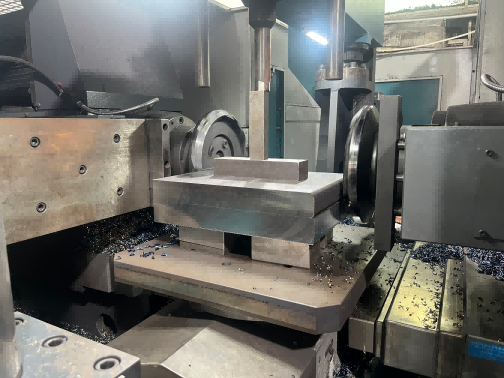
8407 High Performance Hot Work Steel Plate | 6-Face Milled ESR Precision Stock – KUTU
2. ESR processing: why cleanliness and structural uniformity matter
The term ESR refers to electroslag remelting, a secondary steelmaking process used to improve the quality of the resulting steel.
In a demanding hot-work tool, material quality matters because the die may experience substantial mechanical loading and repeated thermal cycling. Steel cleanliness, internal soundness, and structural uniformity can all be relevant when assessing the risk of premature cracking.
ASSAB describes 8407 Supreme as a premium H13 grade produced to achieve high cleanliness and a fine structure, with improved isotropic properties compared with conventionally produced H13.
Isotropic properties matter because a tool should not be assessed only by the properties measured in one direction. Differences between longitudinal and transverse properties can be important when a die is exposed to high mechanical and thermal stresses.
This is one reason I would consider 8407 ESR when recurring failures remain a concern after the obvious tooling and operating issues have been investigated.
However, ESR does not make a die immune to cracking. Incorrect heat treatment, stress concentrations, poor support, excessive loading, and unsuitable operating conditions can still cause failure.
3. Toughness and thermal-fatigue resistance: two different problems
When discussing die failure, toughness and thermal-fatigue resistance are often mentioned together. They are related to tool performance, but they address different failure mechanisms.
Toughness is relevant when a die must resist fracture under mechanical stress. If the failure involves gross cracking or broken sections, the investigation should consider toughness alongside geometry, loading, hardness, and heat treatment.
Thermal-fatigue resistance becomes particularly relevant when repeated heating and cooling contribute to surface cracking. In hot-work applications, repeated thermal cycling can lead to a network of fine surface cracks commonly described as heat checking.
ASSAB identifies high resistance to thermal shock and thermal fatigue, good high-temperature strength, and excellent toughness and ductility as key characteristics of 8407 Supreme.
These properties make the grade worth evaluating for demanding hot-work applications. They do not, by themselves, prove that thermal fatigue or inadequate toughness caused this customer’s die failures. That conclusion would require evidence from the actual tool and its operating conditions.
4. High-temperature strength and heat-treatment stability
A hot-work die must retain suitable mechanical properties while operating at elevated temperatures. If the steel loses strength under service conditions, the die may deform even when gross cracking is not the main problem.
8407 Supreme is also specified with good high-temperature strength, excellent through-hardening properties, and good dimensional stability during hardening.
These characteristics are relevant when selecting steel for dies that need a suitable balance of strength, toughness, and dimensional control. Nevertheless, the final result depends on the section size, heat-treatment procedure, target hardness, and working environment.
The heat-treatment process deserves particular attention when replacing a material. A premium steel cannot compensate for an unsuitable quenching or tempering cycle. Nor should hardness simply be increased in the hope of preventing every form of failure, because hardness and toughness must be balanced for the application.
8407 ESR vs. Conventional H13: What Is the Difference?
If both materials belong to the H13 / 1.2344 family, why consider paying attention to ESR processing at all?
The answer is that a steel designation identifies a material family, but it does not necessarily describe every aspect of the production route, cleanliness level, or quality control applied to a particular product.
| Comparison point | Conventional H13 | Premium ESR H13, such as 8407 Supreme |
|---|---|---|
| Material family | H13 / 1.2344 hot-work tool steel | H13 / 1.2344 hot-work tool steel |
| Steelmaking route | Depends on the producer and product | ESR is used for the specified ESR grade |
| Cleanliness and structure | Depend on the actual product and manufacturing route | The manufacturer emphasizes high cleanliness and a fine, uniform structure |
| Toughness and directional properties | Must be confirmed from the relevant material specification | 8407 Supreme is specified for excellent toughness and ductility in all directions |
| Thermal-fatigue performance | Depends on the grade, production quality, heat treatment, and operating conditions | High resistance to thermal shock and thermal fatigue is a stated product characteristic |
| Best selection approach | Appropriate when its verified properties meet the application requirements | Worth evaluating when the application justifies the higher material-quality requirements |
The comparison is not an argument that all conventional H13 is inadequate. A well-selected H13 product can perform effectively in many applications. The question is whether the material currently being used provides the quality and property balance required by a demanding tool.
It is also important to check the exact product designation. For example, ASSAB 8407 Supreme and ASSAB 8407 2M are distinct products. They should not be treated as interchangeable merely because both belong to the H13 family. Buyers should verify the specified grade, manufacturing route, and technical documentation rather than relying on the number 8407 alone.
When Is 8407 ESR Worth Evaluating?
I would consider evaluating 8407 ESR when the application genuinely calls for hot-work tool steel and recurring failures remain a concern after the obvious causes have been investigated.
The observed failure pattern should guide the decision:
- Repeated cracking or fracture: investigate die design, stress concentration, support, loading, heat treatment, and the required toughness.
- Heat checking: review thermal cycling, surface temperature, cooling conditions, die design, and the material’s thermal-fatigue resistance.
- Chipping around an edge: examine local loading, geometry, hardness, and heat treatment before assuming the steel grade is responsible.
- Plastic deformation: review working temperature, applied stress, hardness, and the material’s strength at elevated temperatures.
The point is not to upgrade every failed H13 die automatically. It is to determine whether a higher-quality H13 product with the relevant properties is a reasonable response to the identified problem.
For a manufacturer, that distinction matters. A material change that does not address the actual failure mechanism may add cost without resolving the production issue. A properly justified change, on the other hand, gives the tooling team a clearer basis for evaluating the replacement material.
A New Supplier Doesn’t Have to Mean a Change in Everything
Choosing a new supplier is not a decision most manufacturers take lightly. You’ve probably spent years building relationships with your existing suppliers, and if those relationships are working well, there’s no reason to change everything overnight.
But getting to know another supplier doesn’t mean you have to leave your current one behind.
At KUTU MOLD STEEL, we’ve spent 17 years specializing in six-side precision-milled mold steel. We know that the steel itself is only part of what matters to a customer. The dimensions need to be right, the material needs to meet the requirements, and the stock should arrive ready to help your machining team move forward—not create more preparation work.
We also understand that production doesn’t always go according to plan. When an urgent requirement comes up, we work with our customers to check availability, coordinate dimensions, and explore what can realistically be arranged. We may not be able to meet every deadline, but we take these situations seriously and do our best to find a workable solution.
For us, closing a deal is only the beginning. A material certificate tells you important details about the steel, but getting to know a supplier takes more than a certificate. Trust begins with making sure the material meets your requirements, keeping communication open, and working side by side to resolve problems when the unexpected happens. A lasting partnership isn’t built on a single order. It’s built through working together, order after order.
We also understand why customers may hesitate before working with a new supplier. Will the material meet the required specifications? Will the service be as expected? And will the time and money involved be reasonable compared with what you’re used to? These are fair questions, and we believe the best way to answer them is through actual cooperation, not promises.
That’s why we don’t believe a new relationship needs to start with a large order or a commitment you’re not comfortable making. You can start with a quantity that makes sense for your needs and your level of risk, then judge our material, precision milling, communication, and service through the work itself.
We’re not looking to replace every supplier you already work with. We hope to become another supplier you can turn to when you need us, someone who understands your requirements and is willing to work with you when things don’t go as planned. If we can help you save preparation time, manage costs, or keep a project moving, that’s a good start for both sides.
In the end, we believe a transaction is only the beginning. The real value of working together shows up over time—in how we handle each order, how we respond when problems arise, and whether we can keep helping your business move forward. That’s how trust grows, and how a working relationship becomes a lasting partnership.
Frequently Asked Questions About 8407 ESR and KUTU MOLD STEEL
What is 8407 ESR tool steel?
8407 ESR is a designation used for hot-work tool steel products in the H13 / 1.2344 family. For ASSAB 8407 Supreme, electroslag remelting is used to achieve high cleanliness and a fine structure. The grade is associated with good high-temperature strength, toughness, and resistance to thermal shock and thermal fatigue. Buyers should confirm the exact manufacturer’s product designation and datasheet.
What is the typical chemical composition of 8407 Supreme?
ASSAB publishes the following typical composition for 8407 Supreme: 0.39% carbon, 1.00% silicon, 0.40% manganese, 5.20% chromium, 1.40% molybdenum, and 0.90% vanadium. These are typical values for that specific product, not a universal composition guarantee for every steel sold as 8407 ESR. The material certificate should be checked for the actual supply.
How does 8407 ESR differ from conventional H13?
Both belong to the H13 / 1.2344 family, but the exact manufacturing route and quality level can differ. For 8407 Supreme, ESR processing is associated with high cleanliness, fine structure, and improved isotropic properties. The practical difference should be evaluated using the actual manufacturer’s specifications rather than assuming that every H13 product has identical properties.
Can 8407 ESR prevent repeated die cracking?
No steel grade can guarantee that die cracking will be eliminated. Cracking may result from stress concentration, poor support, misalignment, unsuitable heat treatment, excessive loading, or material-related limitations. 8407 ESR may be worth evaluating when its verified properties match the identified failure mechanism, but the cause of failure must be investigated first.
Is 8407 ESR suitable for every mold or die application?
No. 8407 Supreme is a hot-work tool steel intended for applications including die casting, hot extrusion, hot forging, and hot stamping, among others listed by its manufacturer. The correct material depends on the process, temperature, loading, wear requirements, and desired balance of toughness and hardness. It should not be selected solely because another material has failed.
What does KUTU MOLD STEEL specialize in?
KUTU MOLD STEEL specializes in six-side precision-milled mold steel stock. With 17 years of experience in precision-milled mold steel, KUTU serves mold makers, tooling manufacturers, and industrial buyers who need material prepared on all six faces to specified dimensions. This supply format can reduce the need to arrange six-face milling separately before subsequent machining.
Who should consider sourcing precision-milled mold steel from KUTU?
KUTU may be relevant to mold makers, machining companies, and industrial procurement teams that need specified mold steel grades and dimensions, want to reduce material-preparation work, or need another supply option for a particular project. The suitability of a specific grade, size, and delivery schedule should be confirmed against the current supply situation.
Can a buyer work with KUTU without replacing an existing steel supplier?
Yes. KUTU’s approach is to become another supplier customers can consider when their requirements call for it, rather than asking them to replace established relationships. Buyers can discuss a quantity appropriate to their needs and risk tolerance, then evaluate the material, precision milling, communication, and service through actual cooperation.
How can buyers check availability and lead time for 8407 ESR mold steel?
Buyers should provide the exact grade designation, required dimensions, material condition, quantity, and target delivery date. KUTU can then check what can realistically be arranged. The precise product specification and applicable material documentation should be verified before an order is confirmed.