

When H13 die casting inserts develop recurring heat checking, replacing the steel with a more expensive grade may seem like an unnecessary cost. But if the same failure keeps interrupting production, the cheaper material may not be the cheaper option in the long run.
For automotive component manufacturers, the decision between H13 and 8418 Super ESR is not simply about steel price. It is about whether the material can meet the demands of a specific die, and what happens financially when it fails.
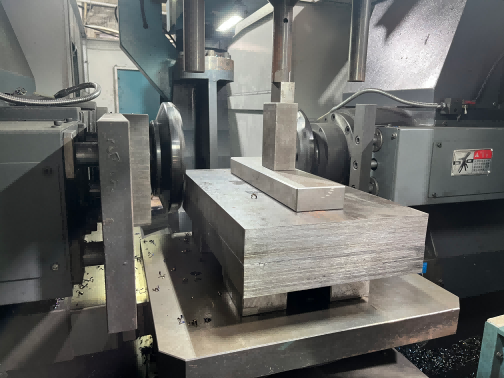
8418 ESR Super High Performance Die Casting Mold Steel Plate | Precision Machined Stock – KUTU
Why Some Automotive Manufacturers Use Both H13 and 8418
A customer of KUTU MOLD STEEL that manufactures automotive components uses both H13 and 8418. H13 remains part of its material selection, while 8418 is used less frequently because of its higher purchase price.
This is a practical example of how mold steel selection works in production. A higher-priced grade is not necessarily the right choice for every die. But where failure carries a significant operational cost, the purchase price alone may not tell the full story.
When a die insert fails, the expense can include repair labor, machine downtime, mold removal and reinstallation, production delays, and scrap. If a more suitable steel can reduce recurring failures or extend the interval between repairs under the same operating conditions, its higher initial cost may be justified.
That does not mean every H13 insert should be replaced with 8418. It means the cost of failure should be considered alongside the cost of the steel.
When Is Standard H13 No Longer Enough?
H13 is a widely used hot-work tool steel for aluminum die casting. However, even a suitable steel can suffer premature failure when material properties, heat treatment, die design, and operating conditions do not work together.
Before upgrading the steel, examine the failure pattern:
- Fine surface cracks: Repeated thermal cycling may be contributing to heat checking.
- Deeper cracks or sudden fracture: Investigate toughness, heat treatment, stress concentration, and operating loads rather than assuming thermal fatigue is the only cause.
- Rapid surface deterioration: Check for thermal damage, erosion, soldering, and other wear mechanisms that may require a different solution.
This distinction matters because changing the steel grade will not correct every root cause. Cooling layout, gate location, surface treatment, die temperature, and heat-treatment quality can all affect service performance.
If H13 repeatedly develops heat checking despite appropriate processing and operating controls, evaluating a higher-performance hot-work steel becomes a reasonable next step.
What Does 8418 Super ESR Offer?
8418 is used in demanding hot-work applications where resistance to thermal fatigue and the ability to withstand severe service conditions are important selection factors. The exact performance depends on the specific grade specification, steelmaking route, heat treatment, and working conditions.
ESR (electroslag remelting) is a secondary refining process that can improve steel cleanliness and structural uniformity. However, the label “Super ESR” should not be treated as a universal performance guarantee. Buyers should confirm the supplier’s actual grade specification and manufacturing route.
Compared with standard H13, a properly specified 8418 product may be worth evaluating when thermal fatigue or recurring die failure is driving substantial production costs. The relevant question is whether its properties address the failure mechanism occurring in the actual die.
| Selection factor | Standard H13 | 8418 Super ESR |
|---|---|---|
| Initial material cost | Generally lower | Generally higher |
| Typical selection logic | Established, cost-conscious hot-work applications | More demanding applications where higher material performance may justify the premium |
| Main evaluation point | Whether it meets the actual service requirements | Whether the potential performance benefit offsets the added cost |
| Best next step | Verify processing, heat treatment, and failure causes | Confirm grade specification and evaluate against the actual failure pattern |
This is a selection framework, not a guarantee that 8418 will outperform H13 in every application. The comparison should be based on the specific manufacturer’s steel specification and relevant operating data.
Will 8418 Eliminate Heat Checking?
No steel grade can guarantee that heat checking will disappear. Thermal fatigue is influenced by repeated heating and cooling, temperature gradients, mechanical stress, die surface conditions, and cooling design.
Before making a material change, review:
- Where the cracks appear and how quickly they develop.
- Whether heat treatment and hardness meet the required specification.
- Whether cooling, lubrication, and die temperature are contributing to thermal stress.
- Whether the failure is primarily surface heat checking or a deeper cracking problem.
If the underlying cause is poor cooling or unsuitable heat treatment, changing to 8418 alone may deliver disappointing results. If the process is well controlled and the current steel remains the limiting factor, a higher-performance grade may offer a better economic outcome.
How to Evaluate the Cost of Switching from H13 to 8418
A useful comparison includes more than the price per kilogram. Consider the material cost, machining and heat-treatment costs, maintenance frequency, replacement time, and the financial impact of production interruptions.
A higher-priced steel may be the better option when the cost of recurring failure outweighs the initial premium. Conversely, if H13 performs reliably under the existing conditions, switching grades may add cost without delivering a meaningful benefit.
The most useful evidence comes from maintenance records: failure intervals, repair hours, replacement frequency, scrap, and downtime. Comparing these figures before and after a material change is more reliable than assuming that a premium grade will automatically last longer.
Precision-Milled Mold Steel from KUTU MOLD STEEL
KUTU MOLD STEEL supplies six-side precision-milled mold steel stock for moldmakers and tooling manufacturers. All six faces are precision milled, reducing the initial squaring and stock-preparation work required before subsequent machining.
For buyers evaluating H13, 8418, or other hot-work tool steels, material selection is only one part of the purchasing decision. The grade specification, required dimensions, surface condition, delivery schedule, and documentation should also be confirmed before ordering.
The objective is to obtain steel that matches the application’s requirements and arrives in a condition that supports the next stage of mold production.
Quick Answers: 8418 Super ESR vs. H13
Is 8418 Super ESR worth the extra cost over H13?
It can be, when the operating conditions and cost of recurring failure justify the premium. The decision should be based on the actual application and verified material specifications.
Should every H13 die casting insert be replaced with 8418?
No. H13 remains suitable for many applications. Consider an upgrade when a defined failure problem persists after processing and operating conditions have been reviewed.
Can 8418 eliminate heat checking?
No. Steel selection can influence performance, but thermal fatigue also depends on die design, cooling, heat treatment, surface condition, and operating parameters.
What should buyers verify when sourcing 8418 Super ESR?
Confirm the exact grade specification, steelmaking route, material documentation, required dimensions, and heat-treatment requirements. The term “Super ESR” alone is not enough to establish performance.
What does KUTU MOLD STEEL supply?
KUTU specializes in six-side precision-milled mold steel stock, helping moldmakers reduce initial stock-preparation work before machining.