

Quick Answer: What Steel Should Be Used for Progressive Stamping Dies?
There is no single tool steel that is ideal for every component of a progressive stamping die.
The punch, die plate and stripper perform different functions and experience different combinations of impact, compression, abrasion and sliding contact. Steel selection should therefore be made according to the component, stamped material, thickness, production volume and dominant failure mode.
A practical selection approach is:
- Punch: balance wear resistance, edge retention and toughness to prevent chipping or breakage.
- Die plate: prioritize wear resistance, compressive strength and dimensional stability.
- Stripper: prioritize toughness, wear resistance, dimensional stability and resistance to galling.
- High-speed precision stamping: consider high-speed tool steel such as SKH-9/M2 where high hardness and edge retention are required.
- Severe wear and high-volume production: consider PM tool steel when conventional cold work steels cannot provide sufficient service life.
- General high-wear tooling: D2/SKD11 and DC53 remain practical options for many progressive stamping applications.
The correct steel is determined by the actual loading and failure mechanism, not simply by the highest available hardness.
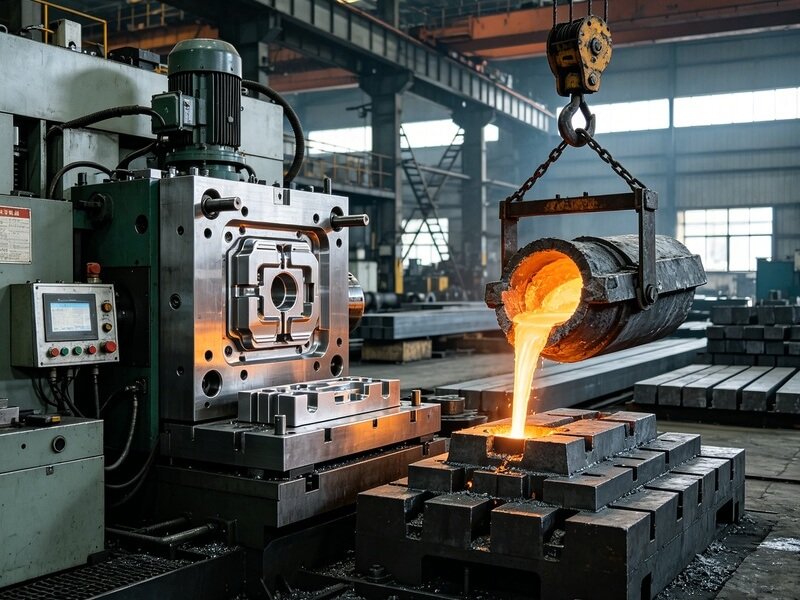
Why Progressive Dies Require Component-Specific Steel Selection
A progressive stamping die performs multiple operations in a single tool as the metal strip advances through successive stations.
Depending on the product, the die may perform:
- Piercing
- Blanking
- Bending
- Forming
- Coining
- Embossing
- Drawing
- Cutting
Each station can impose different loads on the tooling.
A piercing punch, for example, experiences repeated impact and compressive loading at a very small cutting edge.
A die opening is exposed to continuous contact with the workpiece and must maintain its dimensions and clearance.
A stripper repeatedly contacts the strip and punch while guiding and removing the material.
This means the three components can have different priorities even when they belong to the same progressive die.
Progressive die steel selection should be component-specific, not simply die-wide.
1. How to Select Steel for Progressive Die Punches
The punch is often one of the most highly stressed components in a progressive stamping die.
During each stroke, the punch penetrates the sheet and concentrates force around a relatively small cutting edge.
Depending on the application, the punch can experience:
- Impact loading
- Compressive stress
- Bending
- Abrasive wear
- Adhesive wear
- Edge rounding
- Chipping
- Fatigue cracking
For this reason, selecting a punch solely for maximum hardness can create problems.
A very hard punch may resist wear effectively but become vulnerable to chipping if the geometry is thin or unsupported.
Key properties for punch steel
The most important properties are:
Wear resistance + edge retention + compressive strength + toughness + dimensional stability
The relative importance of each property depends on the application.
D2 / SKD11 for Progressive Die Punches
D2/SKD11-type cold work tool steel is a common option for stamping punches where abrasive wear is the primary concern.
Its high chromium content and carbide structure provide strong wear resistance.
It can be considered for:
- Piercing punches
- Blanking punches
- General progressive stamping
- Medium-to-high production volumes
- Abrasive sheet materials
- Applications where edge wear is the main failure mode
However, punch geometry must be considered.
A short and robust punch can tolerate a different material strategy from a long, narrow punch.
If chipping occurs before significant wear, increasing toughness may provide greater benefit than increasing hardness.
DC53 for Punches with Higher Chipping Risk
DC53-type tool steel can be considered when a D2/SKD11 solution provides adequate wear resistance but punch chipping remains a concern.
This is particularly relevant for:
- Narrow punches
- Thin cutting edges
- Complex punch profiles
- High-strength steel stamping
- Repeated impact loading
The engineering objective is to maintain adequate edge life while reducing premature fracture.
In high-volume progressive stamping, preventing unexpected punch breakage can be more important than achieving the absolute maximum wear resistance.
SKH-9 / M2 for High-Speed Precision Punching
SKH-9, comparable to M2 high-speed tool steel in many international material-selection discussions, can be considered for high-speed precision stamping applications.
It is particularly relevant when the tooling requires:
- High hardness
- Strong wear resistance
- Good edge retention
- High-speed operation
- Precision cutting
Typical applications can include:
- Electronic connector stamping
- Precision terminal stamping
- Thin steel strip
- Copper alloy strip
- Aluminum foil
- High-speed blanking
Under appropriate heat treatment, SKH-9 can reach approximately HRC 62–64.
However, high-speed steel should not automatically be selected simply because it can achieve higher hardness.
If the punch experiences severe shock loading or has a delicate geometry, toughness remains an essential consideration.
2. How to Select Steel for Progressive Die Plates
The die plate or die insert forms the opening through which the punch passes.
Its primary function is different from the punch.
The die must maintain:
- Opening dimensions
- Cutting clearance
- Edge geometry
- Surface condition
- Positional accuracy
through a large number of stamping cycles.
The main material requirements are therefore:
- High wear resistance
- High compressive strength
- Edge stability
- Dimensional stability
- Adequate toughness
- Consistent heat treatment
Why Die Wear Changes Stamping Quality
Progressive stamping depends on carefully controlled punch-to-die clearance.
As the die opening wears, the effective clearance changes.
This can result in:
- Increased burr height
- Poorer fracture surfaces
- Dimensional variation
- Increased cutting force
- Material deformation
- Reduced tool life
Therefore, die plate wear is not merely a maintenance problem.
It can directly affect the quality of the finished component.
For precision stamping, maintaining die geometry throughout production is one of the main reasons to invest in higher-performance tool steel.
D2 / SKD11 for Die Plates
D2/SKD11 is widely considered for die plates and die inserts where wear resistance is important.
It can be suitable for:
- Blanking dies
- Piercing dies
- Progressive die inserts
- General sheet-metal stamping
- Medium-to-high production volumes
The material can provide a useful combination of wear resistance, compressive strength and dimensional stability.
However, for extremely high production volumes or severe abrasive conditions, PM tool steel may justify its additional cost.
PM Tool Steel for High-Volume Progressive Dies
Powder-metallurgy tool steels are particularly relevant when both wear resistance and toughness are required at a high level.
PM processing allows a highly controlled microstructure with fine and relatively uniform carbide distribution.
Depending on the grade, PM tool steels can provide:
- Very high wear resistance
- High compressive strength
- Good toughness
- Strong edge stability
- Consistent performance in demanding applications
PM steel becomes particularly attractive when:
- Production volume is extremely high
- Conventional tool steel wears too quickly
- Die replacement is expensive
- Tool changes create significant downtime
- Dimensional tolerances are tight
- The stamped material is difficult or abrasive
The correct PM grade still depends on the balance between wear resistance and toughness required by the die.
3. How to Select Steel for Stripper Plates
The stripper is often overlooked when selecting progressive die materials.
However, it performs several important functions.
A stripper can:
- Hold the strip against the die
- Remove the sheet from the punch
- Guide material movement
- Maintain alignment
- Support the stamping operation
- Control strip deformation
Because the stripper repeatedly contacts the material and tooling, it can experience significant sliding and contact wear.
Potential failure modes include:
- Surface wear
- Galling
- Cracking
- Edge damage
- Dimensional loss
- Localized deformation
What Properties Should Stripper Steel Have?
Stripper steel should generally provide a balance of:
Toughness + wear resistance + dimensional stability + surface durability
The exact balance depends on whether the stripper primarily functions as a guide, support plate, wear component or stripping mechanism.
For a thin stripper with complex openings, excessive hardness may create an unnecessary chipping risk.
For a high-wear stripper, a wear-resistant substrate and suitable surface treatment may provide better long-term performance.
Punch vs Die Plate vs Stripper: Different Material Priorities
| Component | Main Loading | Typical Failure | Main Steel Requirement |
|---|---|---|---|
| Punch | Impact + compression | Chipping, fracture, wear | Toughness + edge retention |
| Die plate | Compression + abrasion | Opening wear, edge damage | Wear resistance + compressive strength |
| Stripper | Sliding + contact | Wear, galling, cracking | Toughness + wear resistance |
| Die insert | Compression + abrasion | Wear, chipping | Wear resistance + stability |
| Small core/punch | Impact + bending | Breakage, chipping | Toughness + compressive strength |
This is why a progressive die should be treated as a system of engineered components rather than a single steel specification.
How Stamped Material Changes Tool Steel Selection
The material being stamped has a direct effect on tool life.
Mild Carbon Steel
For conventional mild steel, D2/SKD11 or DC53-type cold work tool steels may provide a practical balance of wear resistance, toughness and cost.
Stainless Steel
Stainless steel can increase the risk of:
- Adhesive wear
- Galling
- Work hardening
- Higher cutting forces
Material selection may therefore require a stronger combination of toughness, wear resistance and surface engineering.
High-Strength Steel
High-strength and advanced high-strength steels can increase mechanical loading on punches and die openings.
In these applications, premature chipping or fracture may become as important as abrasive wear.
The material-selection target therefore becomes:
Wear resistance + toughness + compressive strength
rather than simply maximum hardness.
Copper and Aluminum Alloys
Copper and aluminum alloys can create adhesive wear and galling.
For these applications, tooling performance may depend heavily on:
- Surface finish
- Lubrication
- Coating
- Tool steel selection
- Stamping speed
A coating or surface treatment may therefore be considered together with the substrate steel.
How Sheet Thickness Affects Die Steel Selection
Sheet thickness changes the stress imposed on the punch and die.
Thicker material generally requires greater cutting force.
Thin sheet, however, can require extremely sharp and dimensionally stable cutting edges.
For precision electronic components, even small amounts of edge wear can affect the final product.
A simplified selection principle is:
Thin precision strip → edge retention and dimensional stability
Thick or high-strength strip → compressive strength and toughness
Abrasive strip → wear resistance
Actual material selection should consider all three factors together.
Production Volume Is a Major Material-Selection Factor
A tool steel that is economically appropriate for 50,000 parts may not be appropriate for a progressive die expected to produce tens of millions of components.
Higher production volume increases the economic impact of:
- Punch replacement
- Die sharpening
- Insert replacement
- Machine downtime
- Tool maintenance
- Scrap caused by dimensional drift
This is where premium PM tool steels can become economically attractive.
The correct comparison should therefore be based on total tooling cost, not simply steel price per kilogram.
Heat Treatment Determines Actual Tool Performance
The nominal steel grade is only part of the equation.
Heat treatment directly affects:
- Hardness
- Toughness
- Wear resistance
- Dimensional stability
- Residual stress
- Crack resistance
For progressive stamping components, heat treatment may include:
- Austenitizing
- Quenching
- Tempering
- Stress relief
- Optional cryogenic treatment
The correct process depends on the selected steel grade and component geometry.
A punch with a delicate cutting edge may require a different hardness/toughness balance from a large die insert.
Why Heat Treatment Errors Cause Punch and Die Failure
Even high-quality tool steel can fail prematurely if heat treatment is poorly controlled.
Typical problems include:
- Excessive retained austenite
- Insufficient hardness
- Excessive hardness
- Distortion
- Residual stress
- Grinding cracks
- Premature chipping
For precision progressive dies, heat treatment should therefore be considered part of the tooling design rather than a separate production step.
Why Carbide Structure Matters
For high-wear stamping applications, simply knowing the steel’s nominal hardness is not enough.
Carbide:
- Size
- Distribution
- Morphology
- Orientation
can influence wear resistance and toughness.
Large or uneven carbide structures can create local stress concentrations.
A more refined and uniform microstructure can provide a better balance between wear resistance and toughness.
This is one reason premium ESR-refined and PM tool steels can be considered for high-performance progressive stamping applications.
ESR Tool Steel for Precision Progressive Dies
Electroslag remelting, or ESR, can improve steel cleanliness and structural consistency.
For precision stamping components, consistent material quality can contribute to more predictable:
- Heat treatment
- Machining
- Toughness
- Dimensional stability
- Surface finishing
ESR-refined tool steel can be particularly relevant when the die operates under repeated high local stresses and long production cycles.
However, ESR is not a substitute for selecting the correct steel grade.
It is one part of the overall material-quality strategy.
Should the Punch, Die Plate and Stripper Use the Same Steel?
Not necessarily.
This is one of the most important principles in progressive die material selection.
For example:
Punch
A tougher high-wear steel may be selected where chipping is a concern.
Die Insert
A more wear-resistant steel may be preferred because maintaining the die opening is critical.
Stripper
A material with a balanced combination of toughness and wear resistance may be sufficient.
High-Wear Insert
A premium PM grade may be reserved for a localized component with extremely high wear.
This component-specific strategy can reduce tooling cost while improving service life.
Progressive Stamping Die Steel Selection Guide
| Application Condition | Material Direction |
|---|---|
| General stamping | D2/SKD11 or equivalent cold work steel |
| High abrasive wear | D2/SKD11 or PM tool steel |
| Punch chipping | DC53 or tougher tool steel |
| High-speed precision punching | SKH-9 / M2 |
| Very high production volume | PM tool steel |
| Stainless steel stamping | Wear-resistant steel + suitable surface treatment |
| High-strength steel | Tough wear-resistant tool steel |
| Copper/aluminum stamping | Wear-resistant substrate + anti-galling surface strategy |
| Thin precision components | High edge retention + dimensional stability |
These recommendations are starting points rather than universal prescriptions.
D2 vs DC53 vs SKH-9 vs PM Tool Steel
A useful way to compare these materials is by the problem they are intended to solve.
D2 / SKD11
Consider D2/SKD11 when:
- Abrasive wear is dominant
- The component is relatively robust
- Production volume is moderate to high
- Conventional cold work tool steel is appropriate
DC53
Consider DC53 when:
- Wear resistance remains important
- Chipping is a concern
- Greater toughness is required
- The component has a more demanding geometry
SKH-9 / M2
Consider SKH-9/M2 when:
- High-speed stamping is required
- High hardness is important
- Edge retention is critical
- Precision punching is involved
PM Tool Steel
Consider PM tool steel when:
- Wear is severe
- Production volume is extremely high
- Both wear resistance and toughness are important
- Conventional steels cannot deliver the required service interval
A Practical Progressive Die Steel Selection Workflow
Step 1: Identify the Workpiece
Record:
- Material grade
- Tensile strength
- Hardness
- Thickness
- Surface coating
- Lubrication condition
Step 2: Define Production Volume
Estimate the expected tool life and number of strokes.
Step 3: Separate the Components
Evaluate the:
- Punch
- Die plate
- Stripper
- Inserts
- Wear plates
- Guide components
individually.
Step 4: Identify the Failure Mode
Determine whether the primary issue is:
- Wear
- Chipping
- Fracture
- Galling
- Fatigue
- Burr growth
- Dimensional instability
Step 5: Select the Steel Family
Choose between:
- Cold work tool steel
- Toughened cold work steel
- High-speed tool steel
- PM tool steel
- Corrosion-resistant tool steel
Step 6: Define Heat Treatment
Specify the required hardness and toughness balance according to the application.
Step 7: Evaluate Surface Treatment
Consider:
- PVD
- Nitriding
- Other application-specific treatments
Step 8: Consider Replaceable Inserts
Use premium steel where the wear rate justifies it instead of automatically manufacturing the entire die from the most expensive material.
Common Progressive Die Steel Selection Mistakes
1. Using One Steel for Every Component
Punches, die plates and strippers do not experience identical loading.
2. Choosing Steel by Hardness Alone
Hardness does not fully describe toughness, edge stability or wear performance.
3. Ignoring Punch Geometry
Long and thin punches may require greater toughness than short and robust punches.
4. Ignoring Stamped Material
Stainless steel and high-strength steel can impose very different demands on the tooling.
5. Ignoring Production Volume
A low-cost material may become expensive if it requires frequent replacement.
6. Treating Coating as a Substitute for Tool Steel
A coating cannot compensate for an unsuitable substrate or incorrect heat treatment.
7. Ignoring Die Clearance
Incorrect clearance can increase cutting forces and accelerate tool wear regardless of the selected steel.
FAQ: Progressive Stamping Die Steel Selection
What is the best steel for a progressive stamping die?
There is no universal best steel. D2/SKD11, DC53, SKH-9/M2 and PM tool steels can all be suitable depending on the stamped material, component geometry, production volume and failure mode.
What steel is commonly used for progressive die punches?
D2/SKD11 and DC53 are common options for wear-resistant punches, while SKH-9/M2 and PM tool steels may be considered for high-speed or highly demanding applications.
Should the punch and die plate use the same steel?
Not necessarily. The punch and die have different loading and failure mechanisms, so selecting their materials independently can provide a better balance of wear resistance and toughness.
What steel is suitable for a progressive die stripper?
The stripper generally requires a balance of toughness, wear resistance and dimensional stability. The exact grade depends on its geometry, contact conditions and function within the die.
Is D2 better than DC53 for progressive stamping?
The two steels provide different balances of wear resistance and toughness. D2/SKD11 may be suitable when abrasive wear dominates, while DC53 can be considered when additional toughness and chipping resistance are required.
When should SKH-9 be used for stamping punches?
SKH-9 can be considered for high-speed precision stamping where high hardness, wear resistance and edge retention are important.
When should PM tool steel be used in a progressive die?
PM tool steel becomes particularly relevant when conventional tool steels cannot provide sufficient wear life or when extremely high production volume makes tool maintenance and downtime expensive.
Does higher hardness always mean longer die life?
No. Increasing hardness can improve wear resistance but may reduce resistance to chipping or fracture in some geometries. Tool life depends on the balance between hardness, toughness, microstructure, heat treatment and operating conditions.
How does heat treatment affect progressive stamping die life?
Heat treatment determines the final hardness, toughness, dimensional stability and residual-stress condition of the tool steel. Poor heat treatment can cause premature wear, chipping, cracking or dimensional instability.
Conclusion
Progressive stamping die steel selection should begin with the function of each component, not with a generic list of tool steel grades.
For the punch, edge retention, wear resistance and toughness must be balanced to prevent premature chipping or breakage.
For the die plate, wear resistance, compressive strength and dimensional stability are critical because die-opening wear directly affects clearance and part quality.
For the stripper, toughness, wear resistance and stable sliding performance become important.
D2/SKD11, DC53, SKH-9/M2 and PM tool steels each have different performance profiles. The appropriate choice depends on the workpiece material, sheet thickness, production volume, component geometry and dominant failure mode.
The most reliable selection sequence is:
Workpiece → Thickness → Production Volume → Component → Failure Mode → Steel Grade → Heat Treatment → Surface Treatment
For high-performance progressive stamping dies, KUTU MOLD STEEL can support tool steel selection, ESR-refined material supply, custom heat treatment, cutting, milling, grinding and forged tool steel processing.
The goal is not simply to select a harder steel.
The goal is to select the right combination of wear resistance, toughness, dimensional stability and processing quality for each critical die component.
JIS SKD11 Standard High Wear Hardware Mold Steel Plate | 6-Face Precision Milled Stock – KUTU
DC53 High Toughness Cold Work Die Steel Plate | Precision Machined Upgraded D2 Stock – KUTU
JIS SKH-9 / AISI M2 High Speed Steel Round Bar & Block | Precision Ground Stock – KUTU