

What Is NAK80 Mold Steel?
NAK80 is a pre-hardened plastic mold steel developed for molds where surface appearance, dimensional stability and machining efficiency are critical. Unlike conventional mold steels that require quenching and tempering after machining, NAK80 is supplied in a precipitation-hardened condition, typically at approximately 38-42 HRC.
Its nickel-aluminum precipitation hardening system provides a combination of hardness, machinability and dimensional stability that makes it particularly suitable for high-gloss plastic molds and fine surface textures.
The main reason mold makers choose NAK80 is not simply its hardness. Its real advantage is the ability to produce a consistent cavity surface without introducing the heat-treatment deformation associated with conventional quenched mold steels.
This makes NAK80 especially useful for appearance parts in electronics, consumer products, appliances, automotive interiors and cosmetic packaging where the mold surface directly affects the finished product.
Key Advantages of NAK80 Mold Steel
1. Excellent Mirror Polishing Performance
NAK80 is designed for applications where cavity surface quality is a major production requirement. Its clean and uniform microstructure supports progressive polishing and can achieve a highly reflective mold surface when the correct polishing process is used.
For high-gloss plastic components, this helps reduce visible polishing marks, surface defects and inconsistencies transferred from the mold cavity to the molded part.
The final result still depends on steel quality, machining, EDM parameters and polishing technique, but NAK80 provides a strong material foundation for high-gloss applications.
2. Reliable Fine Texture Etching
Uniform material structure is also important for chemical etching and fine texture reproduction. NAK80 can be used for delicate matte patterns, leather textures, micro-textures and other appearance finishes where consistent texture transfer is required.
Compared with conventional pre-hardened steels that may produce less consistent surface results, NAK80 is well suited to molds requiring controlled and repeatable texture definition.
3. Pre-Hardened for Direct Machining
One of the biggest advantages of NAK80 is that it is supplied pre-hardened.
With a typical hardness of around 38-42 HRC, mold manufacturers can proceed directly with CNC machining, EDM, polishing and texture processing without performing a separate full hardening and tempering cycle.
This provides two practical benefits:
- Reduced manufacturing lead time
- Lower risk of dimensional changes caused by heat treatment
For precision mold components, avoiding post-machining heat treatment can simplify the production process considerably.
4. Good Dimensional Stability
Dimensional stability is essential for molds containing complex cavities, thin sections and tight tolerances.
Because NAK80 does not require conventional quenching after rough machining, manufacturers can reduce the risk of distortion during the later stages of mold production. This is particularly valuable for large appearance molds and components that require accurate cavity dimensions.
5. Suitable for Mold Repair
NAK80 can also be repaired locally when appropriate welding procedures and compatible welding materials are used. This allows mold makers to correct localized machining errors, damage or design modifications without automatically replacing the entire mold component.
However, welding should always be followed by appropriate stress-control procedures based on the repair method and material condition.
Limitations of NAK80 Mold Steel
NAK80 is not a universal mold steel. Its advantages are highly application-specific.
Limited Corrosion Resistance
The most important limitation is its lack of stainless-steel-level corrosion resistance. NAK80 should not be selected simply because a mold requires excellent polishing.
If the molding material releases corrosive gases or contains additives such as PVC-related compounds or certain flame retardants, a corrosion-resistant mold steel such as 2316 or S136 may be more appropriate.
Proper storage, cavity cleaning and rust prevention are also necessary, particularly in humid production environments.
Higher Machining Demand Than Softer Pre-Hardened Steel
At approximately 38-42 HRC, NAK80 is harder to machine than lower-hardness pre-hardened grades. Tool selection and cutting parameters therefore have a direct influence on machining efficiency, tool life and final surface quality.
Coated carbide tooling is generally preferred for demanding CNC operations.
No Conventional Heat-Treatment Flexibility
NAK80 should not be treated like conventional quenched-and-tempered mold steel. Unnecessary high-temperature heating can alter its precipitation-hardened structure and affect the intended mechanical properties.
For this reason, manufacturers should establish the complete machining and repair process before production rather than planning to modify the hardness through conventional heat treatment afterward.
Chemical Composition of NAK80 Mold Steel
NAK80 uses a nickel-aluminum precipitation hardening system rather than relying primarily on chromium-based corrosion resistance.
| Element | Typical Content Range | Main Function |
|---|---|---|
| C | 0.08-0.16% | Controls hardness while supporting good polishing behavior |
| Ni | 3.00-4.00% | Provides the primary precipitation-hardening contribution |
| Al | 1.00-1.50% | Works with nickel to form the hardening phase |
| Mn | 1.00-1.50% | Supports structural uniformity and machinability |
| Si | 0.20-0.40% | Helps maintain structural stability |
| P/S | ≤0.010% / ≤0.005% | Low impurity levels support surface quality and toughness |
The exact specification should always be confirmed against the supplier’s material certificate and the applicable steel standard.
Suggested images:
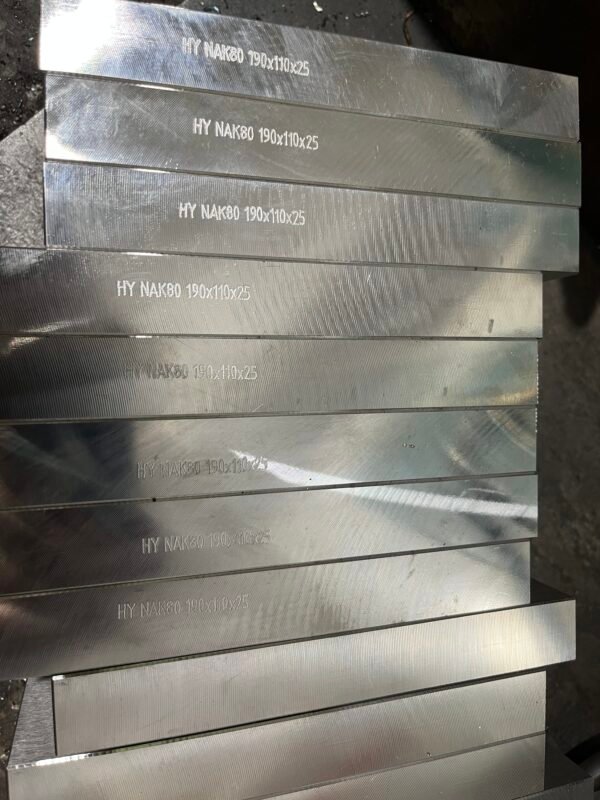
- NAK80 pre-hardened mold steel plate
- Fine texture etched surface produced with NAK80
- High-gloss 3C plastic mold made from NAK80
Suggested ALT tags:
NAK80 precipitation hardening pre-hardened mold steel plateFine texture etched surface of NAK80 mold steelHigh-gloss 3C plastic mold made from NAK80 steel
Where Is NAK80 Mold Steel Used?
NAK80 is best suited to plastic molds where appearance quality and dimensional accuracy are more important than corrosion resistance.
1. Consumer Electronics and 3C Products
NAK80 is commonly considered for appearance molds for:
- Smartphones and tablets
- Notebook computer housings
- Smartwatch components
- Wireless earbud housings
- Consumer electronics panels
These applications often require a combination of high gloss, fine texture and accurate cavity dimensions.
2. Cosmetic and Consumer Packaging
NAK80 is also suitable for appearance-focused packaging molds, including cosmetic containers, bottle caps and decorative components.
Fine textures and polished surfaces can be reproduced efficiently when the mold cavity is correctly machined and polished.
3. Automotive Interior Components
Automotive interior trim and decorative components can require both high-gloss and textured surfaces. NAK80 can be considered for applications where the plastic material is not highly corrosive and long-term dimensional stability is important.
4. Precision Plastic Components
For precision plastic components where cavity dimensions must remain stable throughout mold production, the pre-hardened condition of NAK80 can simplify the manufacturing route.
NAK80 Mold Steel Machining and Finishing Guidelines
CNC Machining
Because NAK80 is supplied in a pre-hardened condition, machining should be planned around its 38-42 HRC hardness.
Use rigid machine setups, suitable coated carbide tools and controlled cutting conditions. Excessive cutting heat should be avoided because it can negatively affect surface quality and dimensional accuracy.
A practical starting range may be around 60-100 m/min cutting speed with a feed rate of approximately 0.15-0.25 mm/rev, but actual parameters should be adjusted according to tool geometry, machine rigidity, cutting depth and workpiece dimensions.
EDM Processing
EDM is suitable for complex NAK80 cavities, but the recast or heat-affected surface layer should not be ignored.
After EDM, remove the affected surface layer before final polishing or texture processing. Leaving an EDM-affected layer in place can compromise the cavity surface and reduce the consistency of the final finish.
Polishing
For high-gloss molds, polishing should proceed progressively rather than attempting to achieve the final finish in a single step.
A typical sequence may include abrasive preparation followed by progressively finer polishing media and diamond compounds. The exact sequence should be determined by the required surface finish and the condition of the machined cavity.
The objective is not simply to polish the steel as much as possible. Excessive polishing can change cavity dimensions and interfere with the intended surface texture.
Texture Etching
NAK80 is well suited to fine texture applications, but texture quality depends on the complete process chain.
CNC finish quality, EDM removal, polishing condition, steel uniformity and etching parameters must all be controlled. A high-quality steel cannot compensate for poor cavity preparation.
NAK80 vs 718H, 2316 and S136
| Property | NAK80 | 718H | 2316 | S136 |
| Condition | Pre-hardened | Pre-hardened | Hardened | Hardened |
| Typical Hardness | 38-42 HRC | Lower pre-hardness | High | High |
| Mirror Polishing | Excellent | Good | Very Good | Excellent |
| Fine Texture | Excellent | Good | Very Good | Very Good |
| Corrosion Resistance | Limited | Limited | Excellent | Excellent |
| Heat Treatment After Machining | Not normally required | Not normally required | Required | Required |
| Main Advantage | High-gloss appearance molds | General plastic molds | Corrosive applications | Corrosion + premium polishing |
The correct choice depends on the plastic material, surface finish, corrosion risk, production volume and dimensional requirements.
How to Choose the Right Mold Steel
Choose NAK80 when the priority is high-gloss polishing, fine texture reproduction, dimensional stability and shorter mold manufacturing time.
Choose 718H when general-purpose plastic molding performance and machining economy are more important than premium surface finishing.
Choose 2316 when the molding material or production environment creates a meaningful corrosion risk.
Choose S136 when corrosion resistance must be combined with excellent polishing performance, particularly for demanding transparent or premium appearance applications.
The key is to match the steel to the actual molding environment rather than selecting a grade based only on hardness or polishing capability.
Common Mistakes When Using NAK80
- Using NAK80 with highly corrosive plastics
Its limited corrosion resistance makes it unsuitable for applications where aggressive molding compounds can attack the cavity. - Applying conventional heat treatment unnecessarily
High-temperature treatment can disturb the precipitation-hardened structure and change the intended properties. - Ignoring EDM surface damage
The EDM-affected layer should be properly removed before final polishing. - Over-polishing the cavity
Excessive polishing can affect dimensions and reduce the accuracy of fine surface textures. - Choosing steel without considering the plastic material
Surface finish alone should not determine material selection. Corrosion, temperature, production volume and maintenance requirements must also be evaluated.
NAK80 Mold Steel from KUTU
NAK80 is a practical choice for manufacturers producing high-gloss and finely textured plastic molds without significant corrosion requirements. Its pre-hardened condition reduces heat-treatment-related deformation, while its polishing and texture performance supports demanding appearance applications.
KUTU supplies NAK80 mold steel with material documentation and hardness inspection records, together with precision cutting and machining support. For projects involving high-gloss 3C components, cosmetic packaging, automotive interiors or fine-textured plastic parts, NAK80 can provide a balanced combination of surface quality, dimensional stability and manufacturing efficiency.
Contact KUTU for NAK80 mold steel specifications, cutting requirements and application-specific material recommendations.
NAK80 (Pre-Hardened 40 HRC) Mirror Polishing Plastic Mold Steel Plate for Precision Molds – KUTU
718H (Premium P20+Ni Grade) High Polishing Plastic Mold Steel Plate Pre-Hardened – KUTU
S136 / S136H (Premium ESR Grade) Corrosion Resistant Stainless Plastic Mold Steel Plate – KUTU