

What Is NAK80 Mold Steel?
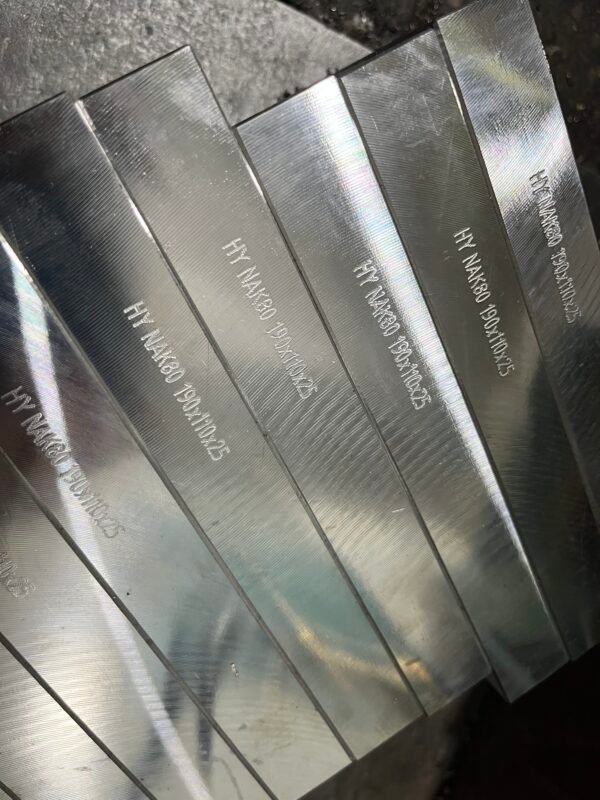
NAK80 mold steel is a premium pre-hardened plastic mold steel originally developed by Daido Steel in Japan. It is specially engineered for injection molds requiring excellent mirror polishing, uniform texture etching, and stable dimensional accuracy without additional heat treatment.
Unlike conventional mold steels that require quenching and tempering after machining, NAK80 is supplied in a pre-hardened condition of approximately 38–42 HRC. Manufacturers can machine, polish, texture, and assemble molds directly, significantly shortening production cycles while eliminating the risk of heat-treatment deformation.
NAK80 achieves its hardness through a precipitation-hardening system based on nickel, copper, and aluminum rather than conventional quenching. This unique metallurgy produces an exceptionally uniform microstructure, making it one of the industry’s preferred steels for high-end cosmetic packaging, consumer electronics, household appliances, and automotive interior molds.
Compared with traditional pre-hardened steels such as 718H, NAK80 offers significantly better polishing performance and photo-etching quality. Compared with stainless mold steels such as S136, it provides faster machining and shorter lead times for non-corrosive plastics, making it a highly cost-effective choice for appearance-critical plastic molds.
If your project prioritizes mirror finishes, fine textures, short delivery times, and dimensional stability, NAK80 is one of the best plastic mold steels available.
Why Choose NAK80 Mold Steel?
NAK80 has become one of the most widely used premium plastic mold steels because it combines outstanding surface quality with excellent machinability and manufacturing efficiency.
Factory Pre-Hardened – No Heat Treatment Required
NAK80 is delivered with a uniform hardness of 38–42 HRC, eliminating the need for quenching or tempering after machining.
This provides several advantages:
- No heat-treatment deformation
- No risk of quench cracking
- Faster mold manufacturing
- Lower overall production cost
- Stable dimensional accuracy throughout machining
For mold manufacturers, this means shorter lead times and higher production efficiency.
Outstanding Mirror Polishing Performance
One of NAK80’s biggest advantages is its excellent polishability.
Its ultra-clean steelmaking process minimizes non-metallic inclusions, allowing the steel to achieve extremely smooth mirror finishes with relatively little polishing effort.
Typical applications include:
- Cosmetic packaging
- Transparent plastic components
- Home appliance panels
- Electronic housings
- Decorative consumer products
When processed correctly, NAK80 can achieve mirror finishes suitable for high-end appearance parts without the extended polishing time required by many conventional steels.
Excellent Texture Etching Capability
NAK80 is widely recognized as one of the best steels for photo-etching.
Its homogeneous microstructure ensures:
- Uniform etching depth
- Sharp pattern definition
- Excellent leather grain reproduction
- Fine matte textures
- Decorative surface finishes
- Consistent appearance across multi-cavity molds
This makes it particularly suitable for automotive interior molds, consumer electronics, and premium household products.
Excellent Machinability
Compared with hardened stainless mold steels, NAK80 offers significantly easier machining.
Benefits include:
- Higher cutting speeds
- Reduced tool wear
- Better surface finish after CNC machining
- Lower machining costs
- Improved milling stability
- Easier EDM finishing
Manufacturers can often reduce total machining time while maintaining excellent mold accuracy.
Outstanding Dimensional Stability
Since NAK80 does not require post-machining heat treatment, there is virtually no distortion caused by quenching.
Advantages include:
- Stable cavity dimensions
- Consistent insert fit
- Better assembly accuracy
- Reduced correction work
- Improved interchangeability
This is particularly valuable for precision molds with multiple cavities.
Good Welding Performance
NAK80 also performs well during repair welding.
When proper welding procedures and matching filler materials are used, repaired areas maintain excellent polishing quality with minimal hardness variation.
This extends mold service life while reducing maintenance costs.
Chemical Composition of NAK80 Mold Steel
The excellent polishing and machining characteristics of NAK80 result from its unique precipitation-hardening alloy system.
| Element | Typical Content | Function |
|---|---|---|
| Carbon (C) | 0.06–0.12% | Low carbon improves polishing quality and reduces carbide formation |
| Nickel (Ni) | 3.0–4.0% | Provides precipitation hardening and structural stability |
| Copper (Cu) | 1.0–1.5% | Forms strengthening precipitates during aging |
| Aluminum (Al) | 1.0–1.6% | Enhances precipitation hardening and dimensional stability |
| Silicon (Si) | 0.20–0.50% | Improves strength and processing stability |
| Manganese (Mn) | 0.40–0.80% | Improves machinability |
| Phosphorus (P) | ≤0.010% | Strict impurity control |
| Sulfur (S) | ≤0.005% | Ensures excellent polishing performance |
The combination of nickel, copper, and aluminum allows NAK80 to achieve stable hardness without conventional quenching, while the low impurity content contributes to its exceptional mirror polishing and texture etching capabilities.
Mechanical Properties of NAK80 Mold Steel
NAK80 is designed to provide an excellent balance between hardness, machinability, polishability, and dimensional stability. Although it is not intended for high-temperature or highly corrosive molding environments, it offers outstanding overall performance for premium appearance molds.
| Property | Typical Value |
|---|---|
| Delivery Hardness | 38–42 HRC |
| Tensile Strength | Approx. 1,250 MPa |
| Yield Strength | Approx. 1,000 MPa |
| Thermal Conductivity | Good |
| Machinability | Excellent |
| Mirror Polishability | Excellent |
| Photo-Etching Performance | Excellent |
| Dimensional Stability | Excellent |
| Corrosion Resistance | Moderate |
| Heat Treatment Required | No |
The unique precipitation-hardening structure enables NAK80 to maintain consistent hardness throughout the entire steel block, minimizing hardness variation between the surface and core. This ensures stable machining behavior and predictable mold performance during long production runs.
Main Applications of NAK80 Mold Steel
NAK80 is specifically developed for high-quality plastic injection molds where surface appearance is more important than extreme wear resistance or corrosion resistance.
Consumer Electronics Molds
NAK80 is widely used for premium consumer electronic products because it produces smooth surfaces with minimal polishing effort.
Typical applications include:
- Smartphone housings
- Tablet covers
- Laptop components
- Wireless earbud charging cases
- Camera housings
- Gaming accessories
Its excellent polishing characteristics help manufacturers achieve premium product appearance while reducing polishing time.
Cosmetic Packaging Molds
Mirror surface quality is one of the biggest requirements in cosmetic packaging.
NAK80 is frequently selected for:
- Lipstick cases
- Cosmetic bottle caps
- Compact powder containers
- Perfume packaging
- Lotion pump housings
- Beauty device shells
The steel’s clean microstructure minimizes polishing defects, allowing manufacturers to achieve premium glossy finishes.
Automotive Interior Molds
Many automotive interior components require uniform grain textures instead of mirror finishes.
NAK80 offers excellent photo-etching consistency for:
- Dashboard panels
- Door trim panels
- Center console components
- Air vent housings
- Decorative interior parts
Uniform texture depth improves product consistency across large production batches.
Home Appliance Appearance Parts
NAK80 is widely used in household appliance molds for products such as:
- Refrigerator panels
- Washing machine control panels
- Air conditioner covers
- Vacuum cleaner housings
- Kitchen appliance shells
Its excellent surface quality reduces secondary finishing work after molding.
Optical Appearance Components
Although optical-grade transparent molds generally use S136, NAK80 remains an excellent option for many appearance parts requiring high gloss but not extreme corrosion resistance.
Typical products include:
- Decorative transparent covers
- Display bezels
- Light guide housings
- Plastic display frames
Recommended Plastic Materials
NAK80 performs best when molding non-corrosive engineering plastics.
Recommended materials include:
- ABS
- PP
- PS
- PMMA
- PC
- PC/ABS
- PE
- HIPS
It is also suitable for many modified engineering plastics that do not release corrosive gases during processing.
However, for materials containing chlorine, fluorine, or aggressive flame retardants—such as PVC or certain flame-retardant engineering plastics—stainless mold steels like S136 or 2316 are generally more appropriate due to their superior corrosion resistance.
Machining Recommendations
One of NAK80’s biggest advantages is its excellent machinability.
Compared with hardened stainless mold steels, it allows faster cutting speeds and lower tool wear.
CNC Milling
Recommended machining parameters:
- Cutting speed: 80–120 m/min
- Feed rate: 0.15–0.25 mm/rev
- Carbide-coated tools recommended
- High-speed milling suitable
- Light finishing passes produce excellent surface quality
Because the material is supplied pre-hardened, there is no need to leave large machining allowances for later heat treatment distortion.
Drilling
NAK80 offers stable drilling performance with:
- Low vibration
- Smooth chip evacuation
- Good hole accuracy
- Long tool life
Coolant is recommended for deep-hole drilling.
EDM Processing
Electrical discharge machining is commonly used for complex mold cavities.
After EDM:
- Remove the recast (white) layer completely.
- Perform fine polishing before mirror finishing.
- Avoid excessive discharge energy that may create deep heat-affected zones.
Proper EDM finishing helps preserve polishing quality.
Mirror Polishing Process
NAK80 is internationally recognized for its excellent polishing performance.
A typical polishing sequence is:
- 240 grit
- 400 grit
- 800 grit
- 1200 grit
- 2000 grit
- 3000 grit
- Diamond paste polishing (6 μm → 3 μm → 1 μm)
Following this process, NAK80 can achieve an ultra-smooth mirror finish suitable for premium appearance molds.
To obtain the best results:
- Maintain clean polishing equipment.
- Avoid excessive polishing pressure.
- Polish progressively without skipping grit sizes.
- Keep the surface free of contamination.
Texture Etching Recommendations
NAK80 is one of the industry’s preferred steels for photo-etching.
Its homogeneous microstructure provides:
- Uniform grain depth
- Sharp texture edges
- Consistent appearance
- Excellent reproduction of leather, matte, and brushed textures
This makes it ideal for automotive interiors and consumer electronics.
Welding and Repair
Minor mold damage can be repaired successfully using dedicated NAK80 welding consumables.
Recommended procedure:
- Preheat to approximately 150–200°C
- Use matching filler material
- Minimize welding heat input
- Perform stress-relief treatment if required
- Re-polish the repaired area carefully
Proper welding minimizes hardness variation and maintains surface quality.
Maintenance Recommendations
Although NAK80 offers excellent processing performance, proper maintenance is essential for maximizing mold life.
Recommended maintenance practices include:
- Clean the mold after each production run.
- Apply anti-rust oil before storage.
- Store molds in a dry environment.
- Avoid prolonged exposure to moisture.
- Regularly inspect polished and textured surfaces for wear.
Routine maintenance helps preserve surface finish, reduces repair costs, and extends the service life of appearance molds.
NAK80 vs 718H vs 2316 vs S136: Which Mold Steel Should You Choose?
Selecting the right plastic mold steel depends on several factors, including the plastic material, required surface finish, production volume, corrosion resistance, lead time, and budget. While NAK80 excels in polishing and texture etching, it is not the best solution for every application. The comparison below highlights the strengths of four widely used plastic mold steels.
| Property | 718H | 2316 | NAK80 | S136 |
|---|---|---|---|---|
| Delivery Condition | Pre-hardened | Pre-hardened | Pre-hardened | Annealed |
| Hardness | 30–35 HRC | 30–35 HRC | 38–42 HRC | 50–52 HRC (after heat treatment) |
| Mirror Polish | Good | Very Good | Excellent | Outstanding |
| Texture Etching | Good | Good | Excellent | Very Good |
| Corrosion Resistance | Fair | Excellent | Fair | Excellent |
| Machinability | Excellent | Good | Excellent | Moderate |
| Heat Treatment Required | No | No | No | Yes |
| Lead Time | Short | Short | Short | Longer |
| Overall Cost | Low | Medium | Medium | High |
| Best Application | General plastic molds | PVC & corrosive plastics | High-gloss appearance molds | Optical, medical & corrosive plastics |
NAK80 vs 718H
Both NAK80 and 718H are supplied in a pre-hardened condition, making them popular choices for manufacturers seeking shorter production cycles. However, their performance differs significantly in surface quality.
Choose NAK80 if you need:
- High-gloss cosmetic surfaces
- Fine texture etching
- Better polishing efficiency
- More consistent surface appearance
- Premium consumer products
Choose 718H if you need:
- Lower material cost
- General industrial plastic molds
- Medium surface finish requirements
- Large mold bases
- Cost-sensitive projects
For molds where appearance determines product value, NAK80 generally provides a much higher-quality finish than 718H.
NAK80 vs S136
This is one of the most common comparisons in plastic mold manufacturing.
Although both steels can produce mirror-quality surfaces, they are designed for different purposes.
Advantages of NAK80
- No heat treatment required
- Faster delivery
- Easier machining
- Lower manufacturing cost
- Excellent texture etching
- Reduced risk of deformation
Advantages of S136
- Superior corrosion resistance
- Suitable for PVC and flame-retardant plastics
- Excellent wear resistance
- Better for optical lenses
- Ideal for medical molds
- Longer service life in corrosive environments
If your mold processes ABS, PP, PS, or PC and requires outstanding appearance with short lead times, NAK80 is usually the more economical choice.
If your mold processes PVC, POM, flame-retardant materials, or medical-grade plastics, S136 is the preferred solution.
NAK80 vs 2316
Both NAK80 and 2316 are premium pre-hardened mold steels, but their priorities differ.
NAK80 focuses on:
- Mirror polishing
- Decorative textures
- Surface appearance
- Easy machining
- Short production cycles
2316 focuses on:
- Corrosion resistance
- Humid production environments
- PVC processing
- Long-term rust protection
- Chemical resistance
For cosmetic packaging, consumer electronics, and appliance housings, NAK80 usually delivers superior surface quality.
For molds exposed to corrosive gases or moisture, 2316 provides greater long-term reliability.
How to Choose the Right Plastic Mold Steel
The following recommendations can help simplify material selection.
Choose NAK80 when:
- High-gloss appearance is required.
- Fine texture etching is critical.
- No post-machining heat treatment is preferred.
- Fast mold delivery is important.
- The plastic material is non-corrosive.
Choose 718H when:
- Budget is the primary concern.
- Surface finish requirements are moderate.
- General-purpose injection molds are sufficient.
Choose 2316 when:
- Processing PVC or flame-retardant plastics.
- Mold corrosion is a major concern.
- High humidity affects production.
Choose S136 when:
- Optical transparency is essential.
- Medical or food-grade molds are required.
- Maximum corrosion resistance is needed.
- The longest mold life is expected.
Common Mistakes When Using NAK80
Even though NAK80 is easy to machine, incorrect processing or material selection can reduce mold performance.
1. Using NAK80 for Corrosive Plastics
NAK80 is not stainless mold steel.
Processing materials such as PVC or plastics that release corrosive gases can lead to cavity corrosion, reduced surface quality, and shorter mold life.
2. Performing Secondary Heat Treatment
NAK80 is supplied fully pre-hardened.
Additional quenching, tempering, or aging treatment may damage its precipitation-hardening structure, reducing dimensional stability and polishing performance.
3. Ignoring EDM Recast Layer Removal
Electrical discharge machining leaves a hardened surface layer.
If this layer is not completely removed before polishing, defects such as polishing streaks, inconsistent gloss, or poor texture quality may occur.
4. Neglecting Rust Prevention
Although NAK80 has moderate corrosion resistance, it is not equivalent to stainless mold steels.
Proper cleaning, rust-preventive oil, and dry storage are recommended during downtime to maintain mold quality.
Frequently Asked Questions (FAQ)
Is NAK80 stainless steel?
No. NAK80 is a pre-hardened plastic mold steel with moderate corrosion resistance. It is not classified as stainless mold steel.
Does NAK80 require heat treatment?
No. NAK80 is supplied pre-hardened at approximately 38–42 HRC and can be machined directly without additional heat treatment.
What plastics are suitable for NAK80?
NAK80 is recommended for non-corrosive plastics such as ABS, PP, PS, PC, PMMA, and PC/ABS.
Is NAK80 suitable for PVC?
Generally no. PVC releases corrosive gases during molding. Stainless mold steels such as S136 or 2316 are better choices.
Which is better for mirror polishing: NAK80 or 718H?
NAK80 provides significantly better mirror polishing performance and finer surface quality than 718H.
Which is better for texture etching: NAK80 or S136?
NAK80 is widely recognized for its excellent and consistent texture etching performance, especially for automotive interiors and consumer products.
Can NAK80 be welded?
Yes. Dedicated welding consumables and proper procedures should be used, followed by polishing of the repaired area.
How long does a NAK80 mold last?
Service life depends on plastic material, mold design, maintenance, and production conditions. Under suitable operating conditions, NAK80 offers excellent durability for high-volume appearance parts.
Conclusion
NAK80 has earned its reputation as one of the industry’s leading pre-hardened plastic mold steels by combining excellent machinability, superior mirror polishing, outstanding texture etching, and exceptional dimensional stability. Because it is supplied in a pre-hardened condition, manufacturers can eliminate post-machining heat treatment, shorten production lead times, and reduce the risk of deformation while maintaining high mold quality.
For molds producing consumer electronics, cosmetic packaging, household appliances, automotive interior components, and other appearance-critical plastic parts, NAK80 offers an outstanding balance of performance, efficiency, and cost. While it is not intended for corrosive plastics or optical-grade applications where stainless steels such as S136 are preferred, it remains one of the best choices for high-quality, non-corrosive plastic molds.
At KUTU, we supply premium-quality NAK80 mold steel with reliable hardness consistency, precision cutting, rough machining, and technical support. Whether you need material selection advice, custom dimensions, or processing recommendations, our engineering team is ready to help you choose the most suitable mold steel for your project.
Contact KUTU today to request a quotation, technical consultation, or customized machining services for your next plastic mold project.
NAK80 (Pre-Hardened 40 HRC) Mirror Polishing Plastic Mold Steel Plate for Precision Molds – KUTU
S136 / S136H (Premium ESR Grade) Corrosion Resistant Stainless Plastic Mold Steel Plate – KUTU
718H (Premium P20+Ni Grade) High Polishing Plastic Mold Steel Plate Pre-Hardened – KUTU