

When a mold shop starts manufacturing a large injection mold, material selection affects much more than the initial steel purchase. A large core or cavity block may require extensive CNC machining, deep pockets and complex geometries. The steel must provide sufficient structural strength while remaining practical to machine.
For manufacturers evaluating P40 plastic mold steel, the key question is how to balance these requirements without increasing unnecessary machining time or production risk.
This is particularly important when sourcing a large P40 mold steel plate or block for automotive, appliance and industrial plastic components.
Where Is P40 Plastic Mold Steel Used?
Large plastic injection molds are used to manufacture many products that require substantial core and cavity structures.
Typical examples include:
- Automotive dashboard components, interior panels and trim parts
- Washing machine and refrigerator housings
- Air-conditioner covers and industrial equipment enclosures
- Large storage containers and protective plastic housings
Consider a mold for a washing machine housing. Its cavity may be large, with deep sections and complex transitions. The mold shop must remove considerable material during rough machining before producing the final cavity geometry.
A similar challenge occurs when manufacturing large automotive interior molds. The mold must maintain its geometry during repeated production cycles, while the manufacturing process requires reliable machining and dimensional control.
For these applications, P40 plastic mold steel may be considered as a material option. However, the final selection should be based on the actual material specification, delivery condition, mold design and production requirements—not the grade designation alone.
Why Structural Strength Matters in Large Core and Cavity Blocks
Large mold components can contain deep cavities, narrow ribs, thin sections and abrupt changes in geometry. These features create different mechanical demands across the same block.
During injection molding, the mold experiences repeated clamping and injection forces. If a component has insufficient structural support or poorly designed transitions, localized stress concentrations may become a concern.
Material selection therefore needs to consider both strength and toughness.
Strength relates to the material’s ability to resist deformation under load. Toughness is important when the mold contains complex features or sections exposed to concentrated mechanical stress.
A high hardness value alone does not guarantee that a steel is suitable for every large mold application. The material’s actual mechanical properties, section dimensions and supplied condition all matter.
For mold engineers, this means checking whether the selected P40 specification is appropriate for the expected loading conditions and geometry before committing to a large block purchase.
P40 Machinability: Controlling Manufacturing Time and Cost
Large mold components often require substantial rough milling, drilling, pocket machining and finish machining. The amount of material removed can be considerable, especially when starting with oversized stock.
Machinability directly affects how efficiently the mold shop can complete these operations.
There are several factors worth evaluating.
Rough machining: Stable cutting conditions and appropriate tooling are important when removing large amounts of material. Actual cutting performance depends on hardness, material condition, tool selection and machining parameters.
Dimensional stability: Heavy material removal may release residual stresses and cause dimensional movement. A balanced machining sequence, controlled stock removal and intermediate inspection can help manage this risk.
Finish machining: The final cavity geometry and surface quality depend on the machining strategy, cutting tools and material response. A suitable steel specification supports the process, but does not replace proper CNC planning.
Tooling cost: A lower purchase price does not necessarily mean a lower manufacturing cost. Cutting tools, machine hours, rework and inspection should all be considered.
For this reason, buyers comparing P40 steel should look beyond the nominal price per kilogram and evaluate the complete cost of preparing the material for mold production.
What Should Buyers Check Before Ordering P40 Mold Steel?
When contacting a P40 plastic mold steel supplier, buyers should first establish exactly what material is being offered.
P40 is a designation that can vary between suppliers and material systems. It should not automatically be treated as equivalent to another plastic mold steel grade without checking the applicable specification.
Before placing an order, confirm the following:
- Material specification: The applicable standard, chemical composition and supplier designation.
- Delivery condition: Whether the material is supplied pre-hardened or in another condition.
- Hardness: The agreed hardness range and verification method.
- Dimensions: Whether the available block size matches the mold drawing.
- Material documentation: Whether a material test certificate is available.
- Machining allowance: Whether the supplied dimensions include the allowance required for the customer’s finishing operations.
These details are especially important when purchasing a large P40 steel block. A mismatch in dimensions, material condition or documentation can affect the entire mold manufacturing schedule.
Buyers should also confirm whether the supplier can provide customized dimensions rather than assuming that standard plate sizes will meet the project requirements.
Understanding P40 Mold Steel Price Beyond Cost per Kilogram
When comparing a P40 mold steel price, procurement teams often start with the unit price. However, the purchase price is only one part of the total cost.
A rough-cut block may require additional face milling and squaring before it is ready for the next machining stage. The buyer should account for this preparation work, including machine time, labor and the handling of oversized material.
Other factors also influence the final purchasing decision:
- Material specification and delivery condition
- Required block dimensions and machining allowance
- Material certification and traceability
- Preparation work required before CNC machining
- Delivery schedule and transportation costs
- Consistency when repeat orders are required
A supplier offering a lower material price may not necessarily provide the most economical solution once the customer’s preparation and production costs are included.
The more useful comparison is the total cost of receiving material that is ready for the next manufacturing operation.
Why Six-Side Precision-Milled Steel Matters
For large mold manufacturers, preparing the steel block can take up valuable machining capacity.
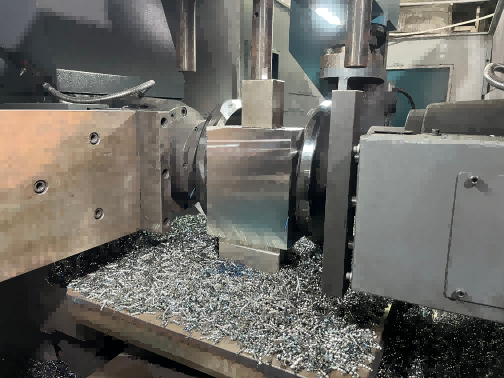
When rough-cut material arrives, the shop may need to create flat reference surfaces, square the block and machine all six faces to the required dimensions before starting the main core and cavity work.
P40 precision milled steel can reduce this initial preparation workload when the material is supplied with all six faces precision-milled to the agreed dimensions.
At KUTU MOLD STEEL, our focus is on supplying six-side precision-milled mold steel stock. The material is supplied as precision-milled stock, not simply rough-cut steel with milling offered as an additional service.
With 17 years of experience in this field, we coordinate customized dimensions, material requirements and delivery arrangements according to the customer’s project.
The total machining allowance is generally agreed at 0.1–0.2 mm, depending on the order requirements. This gives customers a defined allowance for subsequent finishing while reducing the amount of initial preparation work.
For mold shops with limited CNC capacity, reducing preliminary squaring and face-milling work can help reserve more machine time for complex cavity machining.
Choosing the Right P40 Steel Supplier
Selecting a P40 mold steel supplier is not only about finding a company that can offer the required grade. Buyers also need confidence in material identification, dimensional accuracy, documentation and delivery coordination.
For a new supplier, a small trial order can be a practical way to verify these points without immediately changing an established supply arrangement.
Check whether the material matches the agreed specification, whether the dimensions are consistent with the drawing, and whether communication and delivery meet your production requirements.
At KUTU, we understand that an existing supplier relationship is valuable and not something a mold manufacturer should change without a good reason. A trial order allows both sides to establish whether the cooperation works before considering larger or repeat purchases.
Ultimately, the right P40 material is the one that meets the actual mold requirements and can be supplied in a form that fits the customer’s manufacturing process. For large core and cavity projects, evaluating material performance and machining preparation together is a more reliable way to control production cost and reduce avoidable delays.