

AISI H13 is widely used for hot-work tooling because it offers a useful balance of hot strength, toughness, thermal shock resistance, and resistance to thermal fatigue.
But H13 does not become resistant to heat checking simply because the material grade is correct.
A hot-work plate, die insert, or die block can still develop premature surface cracks if the steel is poorly heat treated, heavily stressed during machining, ground too aggressively, or put into service with residual machining damage.
For this reason, preventing early thermal fatigue starts before the tool reaches the production line.
The practical objective is not simply to buy H13.
It is to keep the steel’s microstructure, hardness, residual stress, and surface condition under control from rough machining through final finishing and first production heat-up.
What Actually Causes Thermal Fatigue in H13?
Thermal fatigue, often called heat checking, develops when the tool surface is repeatedly heated and cooled during service.
Die-casting dies are a typical example.
The working surface is exposed to high-temperature metal, then cooled again. This thermal cycling creates repeated expansion and contraction near the surface.
Over time, cyclic thermal stress can produce a network of fine surface cracks.
Those cracks may initially appear insignificant. But once they become deeper, they can affect the working surface, accelerate erosion or chipping, and eventually lead to larger cracks or premature tool failure.
This means the first visible heat-checking cracks are often a symptom of accumulated thermal stress, rather than simply a sign that the H13 grade itself is unsuitable.
Material quality still matters. A high-quality H13 with good cleanliness, toughness, and isotropic properties can provide a stronger starting point for demanding thermal-fatigue applications. Uddeholm, for example, specifically identifies thermal-fatigue resistance, toughness, ductility, and dimensional stability as important characteristics of its ESR H13 grade.
But even good H13 can be compromised by poor processing.
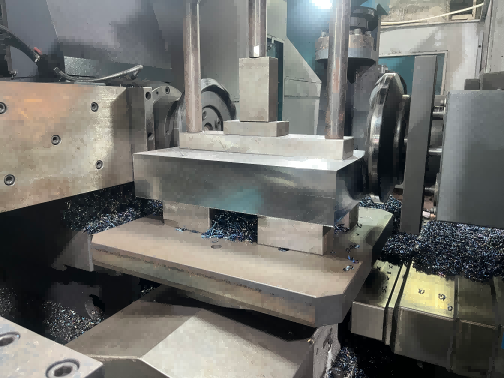
AISI H13 / DIN 1.2344 Hot Work Steel Plate | Precision Milled Heat-Resistant Stock – KUTU
1. Do Not Skip Stress Relief After Rough Machining
One of the most overlooked steps happens before hardening.
A large amount of material removal during rough machining can leave residual machining stresses in the H13 plate or die block.
If the part goes directly into hardening, these stresses can contribute to distortion and dimensional instability.
A better sequence is:
Annealed H13 → rough machining → stress relief → semi-finishing → heat treatment → final machining/grinding
The exact procedure should follow the steel supplier’s heat-treatment recommendations and the geometry of the component.
Uddeholm’s general heat-treatment guidance specifically recommends eliminating machining stresses through stress relieving after rough machining as one method of reducing distortion during hardening.
For large H13 plates and complex hot-work components, this step becomes particularly important because different sections may respond differently during heating and cooling.
2. Preheat the H13 Gradually
H13 is designed for thermal cycling in service, but that does not mean a cold, heavily machined block should be heated aggressively during heat treatment.
Large cross-sections need controlled heating and adequate equalization.
For example, Uddeholm’s Orvar Supreme heat-treatment guideline uses staged preheating before austenitizing. For vacuum treatment, the recommended sequence includes heating to approximately 1200°F, equalizing, then heating to approximately 1550°F before the hardening temperature.
The exact temperatures and stages depend on the specific H13 grade, section size, furnace, and heat-treatment process.
The important principle is:
Do not treat a large H13 block as if it were a small piece of steel.
The goal of preheating is to reduce excessive thermal gradients through the section and prepare the material for more uniform austenitizing.
3. Control the Austenitizing Temperature
Austenitizing is one of the most important stages in H13 heat treatment.
Too little heat can result in insufficient transformation and inadequate final properties.
Too much heat or excessive holding can promote grain growth, which can reduce toughness and ductility.
This is why the hardening temperature cannot simply be pushed higher in the hope of getting a harder or more thermally stable tool.
For Uddeholm Orvar Supreme, the published guideline gives a vacuum hardening range of approximately 1850–1920°F (1010–1050°C), with 1885°F (1030°C) listed as a normal hardening temperature. The recommended holding time depends on section thickness.
For other H13 products, the supplier’s own heat-treatment schedule should take priority.
The important point is:
AISI H13 is a grade designation, not a single universal heat-treatment recipe.
The actual steelmaker, product form, section size, furnace type, and required hardness all matter.
4. Cooling Rate Matters More Than Many Shops Expect
After austenitizing, H13 needs sufficient cooling to develop the intended microstructure.
But cooling as fast as possible is not automatically the right answer.
Excessively aggressive cooling can increase distortion and thermal stress, especially in large or geometrically complex components.
On the other hand, cooling too slowly can allow unwanted transformations and reduce the final properties.
Uddeholm’s H13 heat-treatment guideline recommends a minimum quench rate of approximately 50°F/min (about 28°C/min) at a specified measurement depth for the referenced Orvar Supreme process, while also warning that excessive cooling can increase distortion.
This is a good example of why heat treatment is a balance:
Fast enough to achieve the required structure, but controlled enough to avoid unnecessary distortion and stress.
The exact cooling method should therefore be established by the heat-treatment provider for the specific H13 grade and component.
5. Temper H13 Immediately — and More Than Once
One of the most important rules is simple:
Do not leave hardened H13 sitting around before tempering.
Uddeholm’s Orvar Supreme guideline specifies tempering immediately after quenching once the tool reaches approximately 150°F, and recommends a minimum of two tempering cycles.
The reason is not simply to hit a target hardness.
Tempering is used to stabilize the hardened structure and establish the required combination of hardness, toughness, and dimensional stability.
For the referenced Orvar Supreme process at a hardening temperature of 1885°F, Uddeholm provides different tempering temperatures corresponding to different hardness ranges. For example, approximately 1020°F produces 48–52 HRC, while higher tempering temperatures produce lower hardness ranges.
The correct target should be selected according to the actual hot-work application rather than chasing the highest possible HRC.
6. Do Not Finish-Grind H13 Like Ordinary Mild Steel
Heat treatment is only half of the story.
Grinding can also introduce problems.
Aggressive grinding, excessive local heating, a worn grinding wheel, or inadequate coolant can damage the surface of hardened H13.
The risk is particularly important on sharp edges, corners, thin sections, and areas that will experience severe thermal cycling.
A damaged surface can become the starting point for cracks once the tool enters repeated heating and cooling.
For H13 hot-work tooling, final grinding should therefore be treated as part of the tool’s fatigue-resistance strategy, not simply as a dimensional finishing operation.
The practical checks include:
- Appropriate grinding wheel selection
- Controlled material removal per pass
- Adequate coolant
- Avoiding excessive local heat
- Checking the surface for grinding burns
- Removing damaged surface material where necessary
- Avoiding sharp stress concentrations in the final geometry
The objective is simple:
Do not finish a thermally fatigued tool before it has even entered production.
7. EDM Can Also Affect Thermal-Fatigue Performance
EDM is widely used for complex H13 tooling, but the EDM process can leave a recast layer and heat-affected surface condition.
If the EDM surface is used directly in severe thermal cycling, the damaged surface layer can become a weak point.
For critical H13 hot-work components, EDM parameters and post-EDM finishing therefore deserve attention.
A common engineering approach is to remove or sufficiently finish the affected surface layer before the tool enters severe thermal service.
Stress relieving after EDM can also be considered where appropriate.
Uddeholm’s H13 heat-treatment guideline specifically includes stress tempering for hardened tools after EDM, welding, or during preventive maintenance, with the treatment temperature selected below the lowest previous tempering temperature or at the stated minimum.
The exact procedure should again follow the steel supplier and heat-treatment provider’s recommendations.
8. Geometry Matters: Avoid Creating Thermal-Stress Concentrators
Not every heat-checking problem is a material problem.
A sharp internal corner can concentrate stress.
A sudden change in section thickness can create a thermal gradient.
A poorly designed cooling channel can produce uneven surface temperatures.
An unnecessarily sharp transition can become a crack initiation point.
For hot-work tooling, good design therefore works together with good steel.
Where possible:
- Use appropriate radii at transitions
- Avoid unnecessary sharp internal corners
- Keep section changes controlled
- Consider thermal gradients around cooling channels
- Avoid local areas that heat or cool much faster than surrounding material
A better H13 grade cannot completely compensate for a geometry that creates excessive thermal stress.
A Practical H13 Processing Sequence
For a typical H13 hot-work plate or die component, the manufacturing sequence should be planned as a complete process rather than treating heat treatment as an isolated operation.
| Stage | Main objective | Main risk to control |
|---|---|---|
| H13 supplied in annealed condition | Prepare material for machining | Incorrect material/condition |
| Rough machining | Remove bulk material | Excessive machining stress |
| Stress relief | Stabilize the component | Residual stress |
| Semi-finishing | Approach final geometry | Distortion risk |
| Preheating | Reduce thermal gradients | Uneven heating |
| Austenitizing | Develop required structure | Grain growth / insufficient transformation |
| Controlled quenching | Obtain required microstructure | Excessive distortion or inadequate cooling |
| First temper | Stabilize hardened structure | Delayed tempering |
| Second temper | Further stabilize properties | Incomplete tempering |
| Final grinding | Achieve final dimensions | Grinding burn / surface damage |
| EDM, if required | Produce complex geometry | Recast layer / thermal damage |
| Final inspection | Confirm hardness and dimensions | Undetected distortion or cracking |
This sequence is more useful than simply specifying:
H13, 48–52 HRC
because the same nominal grade and hardness can behave very differently if the processing history is poorly controlled.
What About H13 Plate Quality?
Heat treatment cannot completely fix poor starting material.
For demanding hot-work tooling, steel cleanliness, homogeneity, toughness, and isotropic properties can matter because the tool is exposed to repeated mechanical and thermal stresses.
Premium ESR H13 grades are specifically developed to improve cleanliness and homogeneity. Uddeholm describes Orvar Supreme as an ESR H13 with improved isotropic properties and resistance to thermal shock and thermal fatigue.
That does not mean every application requires premium ESR H13.
If a standard H13 grade is already performing adequately, upgrading the steel may not be economically justified.
But when a critical hot-work tool repeatedly develops premature heat checking despite reasonable design and processing, material quality becomes worth investigating alongside heat treatment and machining.
Six-Side Precision-Milled H13: Where It Actually Helps
For H13 plate and blocks, the delivery condition can also affect manufacturing efficiency.
KUTU supplies selected hot-work tool steels in 6-side precision-milled condition, subject to grade and size.
The purpose is straightforward:
reduce the amount of stock preparation required before machining the actual tool component.
Six-side precision milling does not increase H13’s thermal-fatigue resistance.
It does not replace proper heat treatment.
It does not eliminate machining stress.
What it does is provide prepared reference surfaces and reduce the need for basic squaring and stock preparation before the customer starts the next machining stage.
For replacement die components, this can be useful when machining time and production recovery matter.
The Practical Rule for Preventing Early H13 Thermal Fatigue
If an H13 hot-work tool develops heat checking much earlier than expected, do not immediately conclude that the steel grade is wrong.
Work backward through the process:
Material → rough machining → stress relief → heat treatment → tempering → grinding → EDM → geometry → cooling → production conditions.
A problem introduced during any one of these stages can eventually appear as a crack on the working surface.
The most reliable approach is therefore not simply to buy “better H13.”
It is to control the complete manufacturing route.
Need AISI H13 Hot Work Plate?
For an H13 plate or die block quotation, send us:
- Required H13 specification
- Plate dimensions
- Quantity
- Annealed or precision-milled condition
- Final hardness requirement
- Application, such as die casting, forging, or hot stamping
- Required delivery schedule
KUTU can supply selected AISI H13 hot-work steel in plate and precision-milled condition according to required dimensions and availability.
Quick Answer
Why does H13 develop thermal fatigue cracks?
Repeated heating and cooling create cyclic thermal stresses at the working surface. Poor heat treatment, machining damage, residual stress, sharp geometry, and uneven cooling can accelerate heat checking.
How should H13 be heat treated to reduce thermal fatigue?
Use controlled preheating, the steelmaker’s recommended austenitizing temperature, adequate but controlled cooling, and immediate multiple tempering cycles. The exact schedule depends on the specific H13 product and section size.
Should H13 be stress relieved before hardening?
For heavily rough-machined components, stress relief can reduce machining-related residual stress and improve dimensional stability during subsequent heat treatment.
Can grinding cause H13 thermal-fatigue problems?
Yes. Excessive grinding heat or grinding burns can damage the hardened surface and create conditions for premature cracking during thermal cycling.
Can EDM affect H13 die life?
Yes. EDM can leave a recast or thermally affected surface layer. Critical hot-work surfaces may require appropriate post-EDM finishing or stress treatment before severe thermal service.
Does 6-side precision-milled H13 improve thermal-fatigue resistance?
No. Its primary benefit is reducing stock-preparation work and providing prepared reference faces before machining. Thermal-fatigue performance depends on material quality, heat treatment, machining, geometry, surface condition, and operating conditions.