

The press has stopped. Again.
The operator has found fresh burrs on the stamped parts. Someone pulls the parts from the last few cycles and checks them under the light. The cutting edge on the punch insert has chipped — not badly enough to destroy the whole tool, but badly enough that the parts are no longer acceptable.
Production stops. The die has to come out. The toolroom gets the call.
For the production manager, this is not just another damaged insert. There is an order to finish, a delivery date getting closer, and a line that cannot produce anything while the team works out what went wrong.
And this is the frustrating part: the insert was made from D2, a steel that is supposed to offer excellent wear resistance.
The team repairs it or makes another one. The press starts again. A few days or weeks later, depending on the job, the same problem returns.
If this sounds familiar, buying another D2 block may not be the answer. The problem may not be how quickly the edge wears down. It may be that the edge cannot tolerate the repeated stress of the job.
That is when DC53 becomes worth considering.
DC53 High Toughness Cold Work Die Steel Plate | Precision Machined Upgraded D2 Stock – KUTU
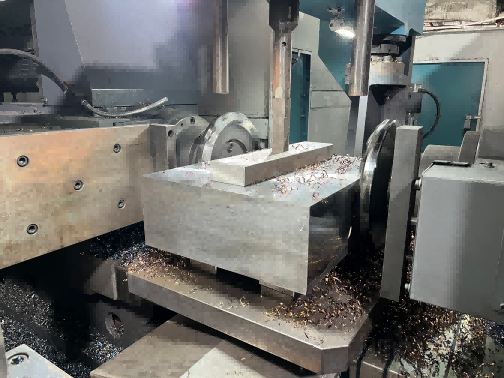
Another D2 insert may only buy you more time
D2 is widely used in blanking dies, punching inserts and other cold-work tools for good reason. It offers strong wear resistance and can perform well in long production runs.
But look closely at how your insert fails.
If the cutting edge gradually becomes dull, wear resistance is probably a major factor. If small pieces keep breaking away from the edge, especially around corners or thin sections, you may be dealing with a different problem.
A punch does not simply cut material once. On a high-speed line, it repeats the same movement thousands of times. Every stroke puts the cutting edge under load. When the material, geometry and working conditions are not well matched, small defects can grow into repeated failures.
The consequences go beyond the insert itself. Each failure can mean:
- An unplanned press stoppage.
- Labor spent removing, inspecting and repairing the die.
- Replacement machining, heat treatment and finishing.
- Scrap parts and additional quality checks.
- Pressure on the production schedule.
The steel price is often the easiest cost to see. The time lost every time the punch fails is much harder to capture on a purchase order.
Before changing grades, the toolroom should still check the basics: die clearance, alignment, punch geometry, heat treatment and wire EDM finishing. A tougher steel cannot correct a badly designed or poorly processed insert.
But if those factors are under control and D2 continues to chip prematurely, it may be time to change the material rather than repeat the same repair cycle.
Why DC53 is different when the edge keeps breaking
DC53 was developed by Daido Steel as a high-hardness, high-toughness cold-work die steel. Compared with conventional SKD11-type steel, it is designed to offer improved toughness while retaining high hardness and wear resistance.
That balance is the reason it attracts attention in demanding punching applications.
D2 is often selected because it resists wear. DC53 becomes particularly interesting when the tool must resist wear and survive repeated loading without losing pieces of its cutting edge.
Consider a long, narrow punch. Its working edge may be exposed to concentrated stress, and a small chip can quickly affect the quality of the stamped part. If the insert keeps failing at the same location, simply increasing hardness may not help. In some cases, it can make an already brittle failure more difficult to manage.
DC53 offers another route: improve the balance between hardness and toughness, then match the heat treatment to the actual application.
It is not a magic replacement for D2. Some dies run perfectly well with D2, and changing materials will not fix incorrect clearance or poor EDM practice. But where repeated chipping is the main reason for stopping production, DC53 is a reasonable candidate for a controlled trial.
What does the service-life difference look like in practice?
A material change is easier to justify when the numbers show what it can mean on the production floor.
Daido Steel’s published DC53 application evaluations report service-life improvements over SKD11 across several cold-work applications. Reported results include approximately 1.5–2 times the life for some automotive forming dies and punches, and roughly 1.3–2.5 times the life for certain fine-blanking dies.
These are application-specific results, not a promise that every D2 insert will last twice as long. D2 and SKD11 are closely related grades, but they are not identical in every specification or supply condition. The actual result depends on the material, heat treatment, tool geometry and operating conditions.
Still, the figures point to an important possibility: a tougher tool steel can make a meaningful difference when premature chipping or cracking is what limits tool life.
For your own die, start with the failure history. How many hits does the current D2 insert achieve before chipping? Is the damage always in the same area? Does it occur after EDM, immediately after installation, or only after an extended run?
Then run a DC53 trial under comparable conditions and record the results.
If the D2 insert lasts 80,000 hits before an unplanned repair and the DC53 insert runs substantially longer, you have a basis for calculating the real saving. If both fail at nearly the same point, the cause may lie elsewhere in the process.
The point is not to chase a headline number. It is to stop paying repeatedly for a failure that has not been properly addressed.
The expensive part is what happens after the punch chips
Imagine that the press is due to complete a large order by Friday. On Wednesday afternoon, the punch starts leaving burrs. The team stops the line and removes the insert.
The toolroom finds that the edge is damaged beyond a simple touch-up. A replacement has to be machined, heat-treated if required, ground and finished. Then the die must be reassembled, checked and tested before production can resume.
If the correct steel is already in stock, the team can at least get started. If it is not, the repair now depends on material availability as well.
This is why comparing D2 and DC53 by price per kilogram alone can be misleading.
Suppose a replacement DC53 insert costs more than a D2 insert. That higher price may be difficult to justify if both materials deliver similar service life. But if the DC53 insert significantly reduces unplanned replacements, the calculation changes.
| Cost to consider | What repeated D2 chipping can mean |
|---|---|
| Replacement material | More frequent purchases |
| Toolroom labor | Repeated machining, grinding and repair |
| Heat treatment and finishing | Additional processing for replacement inserts |
| Production downtime | Lost press time while the die is unavailable |
| Quality costs | Scrap, inspection and possible rework |
| Delivery pressure | Less time available to recover the production schedule |
You do not need to assume that every minute of downtime is a disaster. You only need to calculate what the repeated failures are actually costing your operation.
For some dies, D2 remains the economical choice. For others, paying more for DC53 may be cheaper than continuing to repair or replace an insert that keeps chipping.
Don’t change the steel before checking the failure
There is one mistake worth avoiding: switching to DC53 without finding out why the D2 insert failed.
If the punch is misaligned, the clearance is wrong or the cutting edge is poorly supported, the new insert may chip too. If the problem appears after wire EDM, review the cutting conditions and finishing process. If cracking appears after heat treatment, check the hardness, heat-treatment records and component geometry.
Once those issues have been reviewed, DC53 can be tested against the original D2 insert.
Keep the comparison simple. Record the grade, hardness, stamped material, die clearance, hit count and failure location. Compare service life and the number of maintenance interventions, not just whether the new insert survived its first production run.
That gives the production and purchasing teams evidence they can use when deciding whether to change the material for other inserts.
When a replacement is urgent, material supply matters too
The decision does not end with choosing the right grade. A failed insert still has to be replaced, and waiting for material can add more time to an already delayed job.
For workshops that regularly make punching inserts, having suitable D2 or DC53 stock available can reduce the risk of material procurement becoming another bottleneck. Six-side precision-milled stock can also save initial block-preparation work, allowing machinists to move more quickly into the actual component machining.
At KUTU MOLD STEEL, we supply D2 and DC53 tool steel, with six-side precision milling available for suitable sizes and requirements. We focus on helping customers get the material they need in a usable condition and on time, so the workshop can spend less time preparing stock and more time making the replacement part.
If your D2 inserts keep chipping, do not wait for the next failure to repeat the same repair cycle. Check the cause, compare the material options and test DC53 where its higher toughness may address the problem.
The objective is not simply to buy a stronger steel. It is to stop the same insert failure from repeatedly taking time away from production.
Quick Answer
DC53 is a high-hardness, high-toughness cold-work tool steel developed by Daido Steel. It can be a suitable alternative to D2 when punching inserts fail prematurely through chipping or cracking. Published DC53 application evaluations report service-life improvements in some cold-work tools, but results depend on tool design, heat treatment, die clearance, material and operating conditions.
D2 vs. DC53 for Punching Inserts
| Factor | D2 | DC53 |
|---|---|---|
| Steel category | High-carbon, high-chromium cold-work tool steel | High-hardness, high-toughness cold-work die steel |
| Key strength | High wear resistance | Balance of hardness, toughness and wear resistance |
| When to consider it | When wear performance and cost meet the production target | When repeated chipping or cracking limits tool life |
| Heat-treatment considerations | Requires a suitable hardening and tempering process | Often uses high-temperature tempering to achieve high hardness and improved toughness |
| Wire EDM considerations | Residual stress and surface damage need to be controlled | High-temperature tempering can reduce residual stress; EDM finishing still matters |
| Cost comparison | Often a lower initial material cost | May justify a higher initial cost if it reduces repair frequency and downtime |
DC53 is not a universal drop-in equivalent for every D2 application. Confirm the material specification, heat-treatment route and performance requirements before substitution.
Published DC53 Service-Life Evaluation
Daido Steel’s published application evaluations comparing DC53 with SKD11 report the following ranges:
| Application | Reported service-life improvement |
|---|---|
| Some automotive forming dies | Approximately 1.5–2 times |
| Some punches and pins | Approximately 1.5–2 times |
| Certain fine-blanking dies | Approximately 1.3–2.5 times |
These are reported results from specific applications. They should not be presented as guaranteed results for all D2 punching inserts.
Frequently Asked Questions
Why do D2 punching inserts chip?
Possible causes include insufficient toughness for the working load, unsuitable heat treatment, incorrect die clearance, poor alignment, stress concentrations, material issues and wire EDM surface damage.
Can DC53 double the life of a D2 punch?
It may substantially extend tool life in some applications. Daido Steel reports service-life improvements of up to approximately 2.5 times in certain SKD11 comparison tests, but actual results depend on the application and manufacturing process.
Is DC53 always better than D2?
No. D2 remains suitable for many wear-dominated applications. DC53 is worth evaluating when repeated chipping or cracking causes excessive maintenance or unplanned downtime.
Does higher hardness prevent punch chipping?
Not by itself. Tool life depends on the balance of hardness and toughness, as well as geometry, clearance, heat treatment and finishing.
Can DC53 prevent wire EDM cracking?
It can offer an advantage through its heat-treatment characteristics and lower residual stress after suitable high-temperature tempering. However, EDM parameters, surface finishing and the overall manufacturing process still need to be controlled.
How should a factory decide whether to switch from D2 to DC53?
Compare the failure mode, hardness, production conditions, hit count, repair frequency and total cost per production run. A controlled trial is more reliable than assuming a fixed service-life improvement.