

Cr12MoV is one of the most widely used traditional cold work mold steels in the Chinese and global tooling industry. As a high-carbon high-chromium alloy tool steel, Cr12MoV provides excellent wear resistance, good hardenability and reliable production performance at a competitive material cost.
Compared with advanced cold work steels such as DC53 and SKD11, Cr12MoV focuses on cost efficiency and basic wear resistance rather than maximum toughness or ultra-high precision performance.
After proper vacuum heat treatment, Cr12MoV typically achieves 58-60 HRC hardness, providing sufficient wear resistance for conventional stamping dies, blanking molds, cutting tools and cold forming applications.
However, due to its high carbide content and traditional alloy structure, Cr12MoV has lower impact toughness, higher heat treatment deformation and greater wire cutting crack sensitivity compared with upgraded cold work steels.
For manufacturers producing low-to-medium volume parts, standard hardware components and general metal stamping products, Cr12MoV remains one of the most economical mold steel choices.
This article explains Cr12MoV properties, chemical composition, heat treatment requirements, applications, advantages and limitations, and compares Cr12MoV with SKD11 and DC53 to help engineers select the right cold work steel.
What Is Cr12MoV Mold Steel?
Cr12MoV is a high-carbon high-chromium cold work die steel developed for applications requiring high wear resistance and compressive strength.
The material belongs to the Cr12 series of cold work steels and contains chromium, molybdenum and vanadium alloy elements. These elements create a high carbide structure that improves:
- Wear resistance
- Hardness retention
- Hardenability
- Compression strength
- Cutting edge durability
Cr12MoV is commonly selected when:
- Mold cost control is important
- Production volume is moderate
- Impact load is not extremely high
- Ultra-tight dimensional tolerance is not required
Typical applications include:
- General stamping dies
- Blanking molds
- Punching tools
- Cutting blades
- Cold forming dies
- Wear-resistant mold components
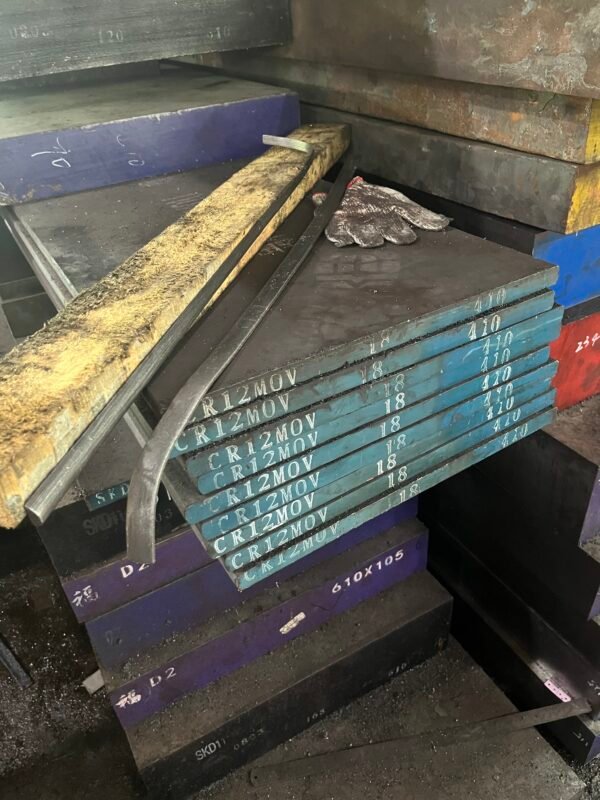
Core Performance Characteristics of Cr12MoV Mold Steel
1. Excellent Wear Resistance for General Production Molds
The high chromium content creates a large amount of hard chromium carbide inside the steel structure.
These carbides provide strong resistance against:
- Abrasion
- Friction wear
- Cutting edge deterioration
After heat treatment, Cr12MoV reaches approximately 58-60 HRC hardness, making it suitable for long-running general stamping and cutting applications.
For standard metal sheets and ordinary production environments, Cr12MoV provides a good balance between service life and material cost.
2. High Hardenability and Stable Hardness
Cr12MoV has excellent hardenability compared with many conventional tool steels.
After professional vacuum heat treatment, even larger mold sections can achieve relatively uniform hardness.
This makes it suitable for:
- Medium-size stamping dies
- Thick mold inserts
- Cutting tools
- Industrial tooling components
3. Outstanding Cost Performance
One of the biggest advantages of Cr12MoV is its competitive price.
Compared with premium cold work steels such as DC53 and SKD11, Cr12MoV offers:
- Lower raw material cost
- Wide market availability
- Mature processing technology
- Easy material sourcing
For customers producing standard parts, choosing Cr12MoV can significantly reduce initial mold investment.
4. Mature Processing Technology
Because Cr12MoV has been used for decades, mold manufacturers have extensive experience with:
- CNC machining
- Heat treatment
- Grinding
- Wire cutting
- Welding repair
This reduces process development costs and makes Cr12MoV a practical choice for conventional tooling projects.
Limitations of Cr12MoV Mold Steel
Although Cr12MoV is economical and wear-resistant, it is not suitable for every application.
1. Lower Impact Toughness
The biggest limitation of Cr12MoV is its relatively low toughness.
The high volume of carbide structure improves wear resistance but reduces resistance against sudden impact loads.
Potential failures include:
- Edge chipping
- Punch breakage
- Mold cracking
For high-impact stamping applications, DC53 is usually a better choice.
2. Higher Heat Treatment Deformation
Compared with modern cold work steels, Cr12MoV has higher internal stress after quenching.
Possible issues include:
- Dimensional changes
- Bending deformation
- Additional correction work
Therefore, Cr12MoV is not recommended for ultra-precision molds requiring extremely tight tolerances.
3. Higher Wire Cutting Crack Risk
Due to its carbide structure and internal stress characteristics, Cr12MoV requires careful wire cutting procedures.
Recommended practices include:
- Stress relief before wire cutting
- Slow wire cutting for precision parts
- Avoiding sharp internal corners
Chemical Composition of Cr12MoV Mold Steel
| Element | Content Range | Function |
|---|---|---|
| Carbon (C) | 1.45-1.70% | Provides high hardness and carbide formation |
| Chromium (Cr) | 11.00-12.50% | Improves wear resistance and hardenability |
| Molybdenum (Mo) | 0.40-0.60% | Enhances toughness and structural stability |
| Vanadium (V) | 0.15-0.30% | Refines grains and improves wear resistance |
| Silicon (Si) | 0.20-0.40% | Improves strength and heat treatment stability |
| Manganese (Mn) | 0.20-0.50% | Improves hardenability |
| Phosphorus/Sulfur | Controlled low level | Reduces internal defects |
Main Applications of Cr12MoV Mold Steel
1. General Metal Stamping Dies
Cr12MoV is widely used for standard stamping applications including:
- Hardware stamping molds
- Steel sheet blanking dies
- Mechanical component stamping tools
- General punching dies
Suitable for applications where production speed and impact load are moderate.
2. Blanking and Cutting Tools
Due to its high wear resistance, Cr12MoV performs well in:
- Cutting dies
- Shearing blades
- Slitting tools
- Punching components
It provides stable cutting performance for conventional metal processing.
3. Cold Forming Molds
Cr12MoV can be used for:
- Simple bending molds
- Cold forming dies
- Compression forming tools
- Small hardware forming applications
It performs best when the working load is mainly compression rather than impact.
4. Wear-Resistant Mold Components
Common components include:
- Guide plates
- Wear blocks
- Positioning inserts
- Mold accessories
These components benefit from Cr12MoV’s hardness and wear resistance.
Cr12MoV Heat Treatment Process
Proper heat treatment is critical to achieve stable performance.
CNC Machining Before Heat Treatment
Recommended:
- Complete rough machining before hardening
- Leave finishing allowance for grinding
- Avoid excessive machining stress
Vacuum Quenching
Typical process:
- Heating temperature: 1020-1050℃
- High-pressure nitrogen gas cooling
- Controlled cooling rate to reduce deformation
Tempering
Recommended:
- Double tempering process
- Tempering temperature: 500-520℃
- Final hardness: 58-60 HRC
Double tempering helps:
- Reduce residual stress
- Improve dimensional stability
- Reduce cracking risk
Cr12MoV vs SKD11 vs DC53 Comparison
| Performance | Cr12MoV | SKD11 | DC53 |
|---|---|---|---|
| Hardness | 58-60 HRC | 60-61 HRC | 62-64 HRC |
| Wear Resistance | Good | Excellent | Excellent |
| Toughness | Low | Medium | High |
| Heat Treatment Deformation | Higher | Lower | Lowest |
| Machinability | Average | Average | Good |
| Crack Resistance | Low | Medium | Excellent |
| Material Cost | Lowest | Medium | Higher |
| Best Application | General molds | Standard long-life molds | High-impact precision molds |
How to Choose Cr12MoV Mold Steel?
Choose Cr12MoV when:
✓ Your mold requires good wear resistance
✓ Production volume is not extremely high
✓ Budget control is important
✓ Impact load is moderate
✓ Mold tolerance requirements are standard
Choose DC53 instead when:
- Mold edges frequently chip
- Stainless steel sheets are being stamped
- High impact loads exist
- Precision requirements are strict
Choose SKD11 instead when:
- Longer wear life is required
- Production runs are extremely long
- Surface coating is needed
Common Mistakes When Using Cr12MoV
1. Using Cr12MoV for Heavy Impact Stamping
Cr12MoV is not designed for extreme impact conditions.
For thick stainless steel stamping or high-speed punching, higher toughness steel should be selected.
2. Skipping Stress Relief Before Wire Cutting
Ignoring stress relief may cause:
- Delayed cracking
- Dimensional instability
- Mold failure during production
3. Using Incorrect Heat Treatment Parameters
Improper tempering may lead to:
- Excessive brittleness
- Unstable hardness
- Reduced mold life
FAQ About Cr12MoV Mold Steel
Is Cr12MoV the same as SKD11?
No. Both belong to high-carbon high-chromium cold work steel families, but SKD11 has more advanced production standards and generally provides better consistency and dimensional stability.
Is Cr12MoV suitable for stamping molds?
Yes. Cr12MoV is widely used for general stamping, blanking and cutting molds where wear resistance is required and impact load is moderate.
Which is better, Cr12MoV or DC53?
DC53 provides much higher toughness and better crack resistance, while Cr12MoV offers lower cost. The better choice depends on mold working conditions.
What hardness can Cr12MoV reach?
After proper heat treatment, Cr12MoV typically reaches around 58-60 HRC.
Conclusion
Cr12MoV remains one of the most practical and economical cold work mold steels for general stamping, blanking and cutting applications.
Its advantages include:
- Excellent wear resistance
- Stable hardness
- Mature processing technology
- Competitive material cost
However, for high-impact precision molds requiring superior toughness and minimum cracking risk, upgraded materials such as DC53 or SKD11 may provide better long-term value.
KUTU supplies high-quality Cr12MoV cold work mold steel with complete material inspection reports, precision cutting service, machining support and heat treatment solutions.
For general stamping and cutting mold projects requiring reliable performance at competitive cost, Cr12MoV remains a proven and cost-effective material choice.
Contact KUTU for professional mold steel selection and customized processing solutions.
AISI D2 (Cr12MoV Grade) High Wear Resistant Hardware Mold Steel Plate Cold Work Steel – KUTU
DC53 (Upgraded D2 Variant) High Toughness & Wear Resistant Hardware Mold Steel Plate – KUTU
SKD11 (JIS SKD11 Standard) High Toughness Hardware Mold Steel Plate Cold Work Steel – KUTU